Electronic City
Workstation Manufacturer in Electronic City — Buying Furniture That Can Still Be Matched in 2030
Why standardisation and record-keeping decide whether Electronic City offices can extend workstation runs years later, and what specification details to lock down now.
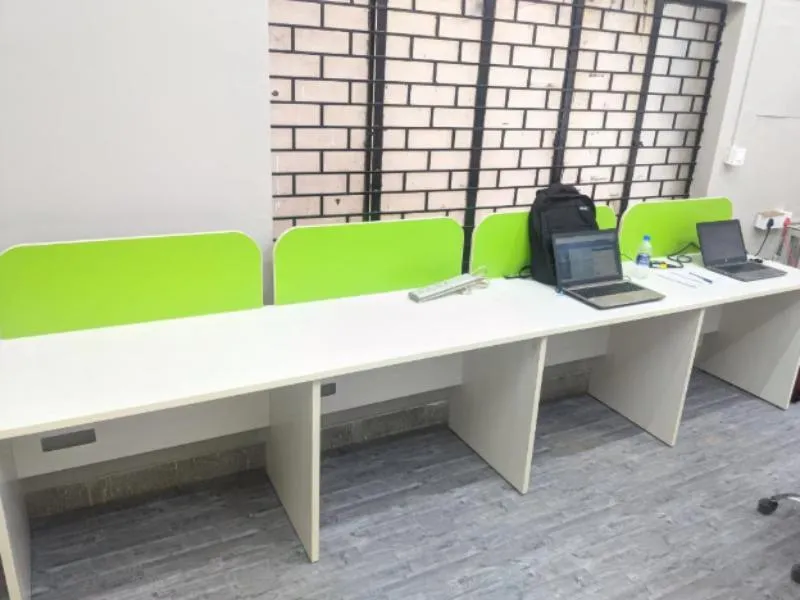
Here is a situation that happens in almost every growing office. You bought 40 workstations three years ago. You now need eight more. You call the supplier. The laminate has been discontinued, the frame section has changed, and the new desks are 15 mm different in height.
So you either accept a visibly mismatched corner of the office, or you replace forty perfectly good desks to make eight new ones match. Neither is a good outcome, and both were avoidable.
What actually has to match
Not everything needs to be identical. In practice the eye notices, in descending order:
- Worksurface height. A 15 mm step where two runs meet is glaring. This is the one thing that must be exact.
- Laminate shade. Even within a nominally identical code, batches vary. Adjacent desks show it; desks across a room do not.
- Screen height and fabric. Very visible in a continuous run.
- Edge band colour and thickness.
- Frame finish. Powder coat shades drift between batches.
Frame section, hardware brand and board manufacturer matter for performance but are largely invisible.
The record to keep
Ask your supplier, at handover, for a written specification containing:
- Worksurface: board type, thickness, laminate code and manufacturer, both faces
- Edge band: material, thickness, colour code
- Frame: section size, wall thickness, powder coat shade code
- Screen: height above finished floor, infill type, fabric code
- Hardware: hinge, slide and lock models
- Module widths and depths used
- Drawing set for each unit type
Store it somewhere your successor will find it. Two lines in a facilities file is the difference between a matched extension and a compromise.
Standardise while you can
The decision that makes future extension possible is made at the first order, not the second: use as few distinct module sizes as you can live with. Two or three widths across the whole office. Every one you add multiplies the coordination problem later.
Similarly, keep one screen height and one laminate across the floor. Variety is easy to introduce later; consistency is impossible to retrofit.
Keep a small buffer
For offices expecting growth, ordering three to five per cent extra at the outset is inexpensive insurance. A spare worksurface, a spare screen and a spare pedestal cost little and guarantee an exact match for the first repair or addition. The alternative is a special order for one desk, at a poor rate, in a laminate that no longer exists.
Why a local manufacturer helps here
A trader ordering from a factory has no control over whether a product line is discontinued. A manufacturer holding the drawings and the laminate code can produce a matching unit years later because the tooling is a cutting list, not a mould.
We keep the specification and drawing set for every project we produce at our workshop at #336/10, Hosur Road, Bommanahalli, so an Electronic City office that grows from 40 seats to 60 gets furniture that matches rather than approximates.
To discuss a workstation programme built for extension, call +91 98807 93666 or email info@srirangainterior.com.