Bengaluru
Which Workstation Type Fits Your Bengaluru Floor Plan?
Linear, L-shaped, cluster, benching, cubicle and ESD workstations compared for Bengaluru offices — footprint, seat density, privacy and what each configuration suits.
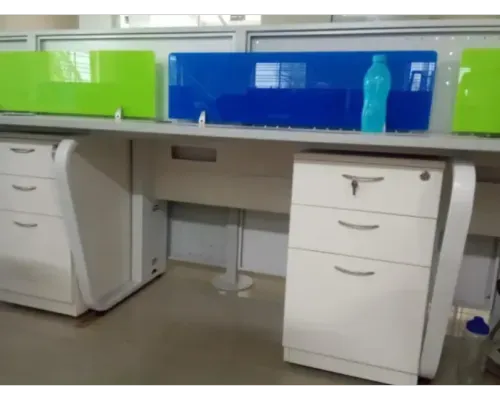
“Workstation” covers half a dozen distinct configurations that behave differently in a floor plan. Choosing the wrong one is the most common reason an office feels cramped despite having adequate square footage.
Here is what each type is and what it suits.
Linear / straight run
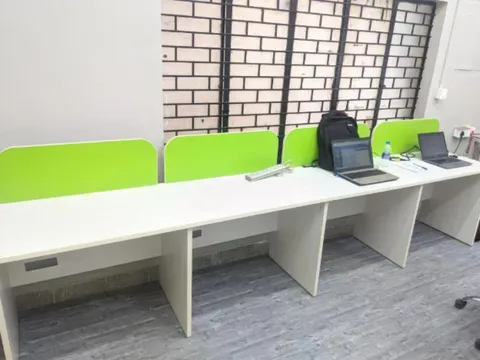
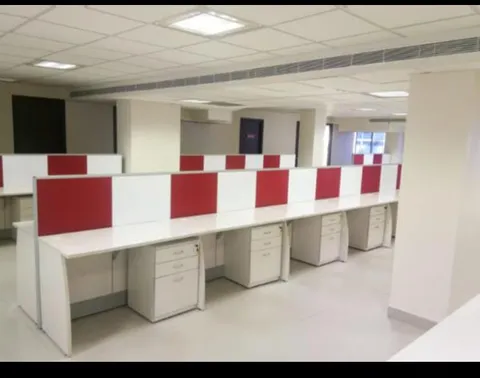
Desks in a row along a shared spine, all facing the same direction or in back-to-back pairs.
- Density: highest available with defined seats
- Extension: the easiest — add a module at the open end
- Privacy: low, moderated by screen height
- Suits: support functions, calling teams, high headcount on limited floor area
- Watch: a run terminating against walls at both ends can never grow
L-shaped / corner workstation
A main worksurface with a perpendicular return.
- Density: low. Each seat consumes considerably more floor area
- Work surface: the largest of any type — two working planes
- Suits: accounts, administration, paper-intensive roles, senior staff on the open floor
- Watch: the corner itself is often dead space unless a monitor sits in it
Cluster / pod
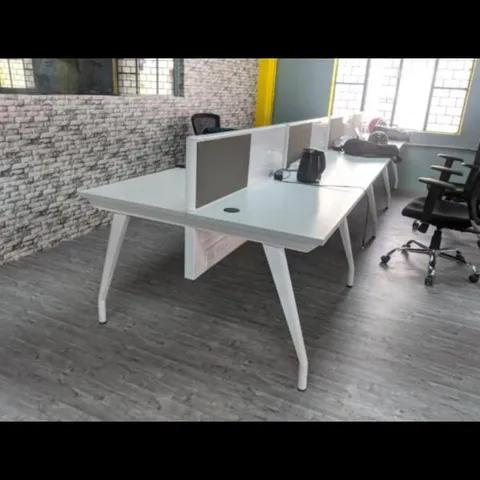
Four, six or eight desks radiating from a central spine in a cross or star.
- Density: moderate
- Team identity: the strongest of any open-plan type
- Services: one power and data feed serves the whole pod
- Suits: stable delivery teams, project groups
- Watch: needs about 7 m of floor width to work; extends only by whole pods
Benching
A continuous shared surface with no dividing screens and often no assigned seats.
- Density: very high
- Cost per seat: the lowest, since there is one structure and no screens
- Suits: project rooms, hot-desking, reserve capacity, collaborative teams
- Watch: no privacy and no acoustic mitigation at all. Not suitable for concentration-heavy work
Cubicle
High panels, typically 1500-1800 mm, fully enclosing each seat.
- Density: low to moderate
- Privacy: the highest of any open-plan type
- Suits: roles handling confidential material, or work requiring sustained concentration
- Watch: blocks daylight and sightlines. A floor of cubicles feels considerably smaller than the same floor in clusters
ESD workstation
A technically distinct category rather than a layout choice — a bench with dissipative worksurface, grounding studs, bonded frame and a common point ground, for handling electrostatic-sensitive components.
- Suits: electronics assembly, test, rework and laboratory environments
- Watch: bench height must follow posture — 750 mm seated, 900-950 mm standing — and not be standardised across mixed operations
Comparison
| Type | Seat density | Privacy | Ease of extension |
|---|---|---|---|
| Linear | High | Low | Very easy |
| L-shaped | Low | Low-moderate | Easy |
| Cluster | Moderate | Moderate | By whole pods |
| Benching | Very high | None | Very easy |
| Cubicle | Low-moderate | High | Easy |
Most offices need two or three
The best floors we work on are rarely uniform. A typical arrangement: clusters for delivery teams, a linear run for support functions and growth capacity, one or two L-shaped seats for accounts, and a benching run held as a project area.
Provided the worksurface height, laminate, edge detail and screen system are identical across all of them, a mixed floor reads as one coherent system rather than a collection of purchases.
We manufacture all of these office workstation configurations at our own workshop at #336/10, Hosur Road, near ICICI Bank, Bommanahalli, Bengaluru 560068, on a single specification so they match across a floor.
Call +91 98807 93666 or email info@srirangainterior.com.