Uttarahalli
T-Type Workstations in Uttarahalli: Scaling a Team from Three to Twelve
How T-type clusters grow with a team without redesigning the floor. Cluster combinations, supervision layouts and growth planning for Uttarahalli offices.
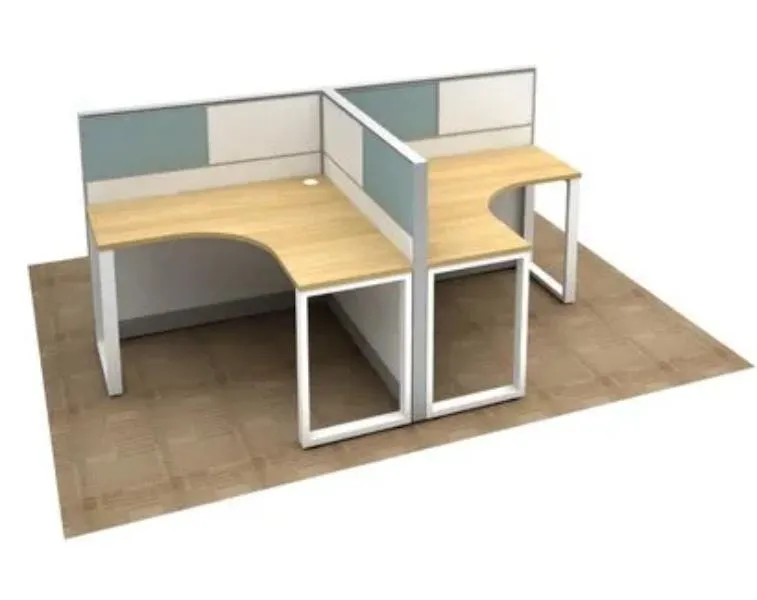
The awkward stage for any growing team is between about six and fifteen people. Below six, everyone talks to everyone. Above fifteen, the team has structure and sub-groups. In between, the team is changing shape every few months, and furniture bought for the shape it had last quarter is wrong by the next one.
T-type workstations handle this stage better than most layouts, because the cluster is small enough to be a building block rather than a fixed arrangement.
The base unit
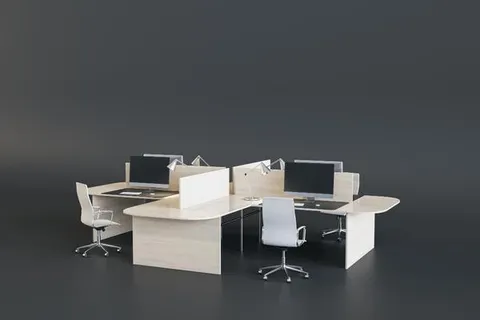
A T-type cluster is three desks around a central spine: one at the head, two on the stem. Three is a useful base unit because it is the smallest group that has any internal structure, and because it fits into an awkward floor area that a four-seat square cluster will not.
Growth patterns
Three to six. Add a second T, placed back to back with the first so the two spines meet. Services run through the joined spine, so the second cluster typically shares the first cluster’s supply point. The two teams face away from each other, which keeps them distinct.
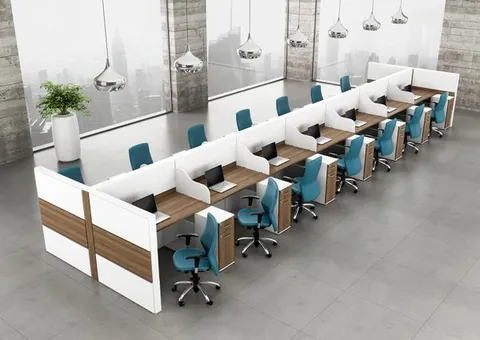
Six to nine. A third T. At this point the arrangement should be planned rather than accreted — three clusters in a line reads as a team; three clusters scattered reads as an accident. Set the line against a circulation route so each cluster has a clear approach.
Nine to twelve. Four clusters, and this is where you should reconsider the arrangement rather than just add another. A 2 × 2 block of Ts gives twelve seats with a natural crossing in the middle, and it creates a defined team territory that a line of four does not.
Beyond twelve, either the team has sub-groups — in which case cluster them separately — or a different layout will serve better.
Supervision at each scale
The reason T-clusters suit growing teams is that they preserve sightlines while the team is small enough for direct supervision to work.
- Three seats: the head-of-T position is naturally the lead. Everyone is within a metre.
- Six: the lead sits at the head of one T, with sightlines across both clusters if screen heights are kept at or below 1200 mm.
- Nine to twelve: direct sightline supervision stops working, and the lead should have a position with a view across the block rather than within a cluster.
Screen height is the variable that makes or breaks this. A team that raises screens to 1350 mm for privacy has, without noticing, ended supervision by sightline. That may be the right trade — but it should be a decision.
What to standardise so growth stays cheap
Growth is cheap only if the second order matches the first. That means fixing, at the outset:
- One desk size across all clusters
- One screen height — or two, deliberately, with a documented rule for which goes where
- One finish, recorded, with batch details kept
- One spine and connector specification
An office that standardises these can add a cluster in a fortnight. An office that treated the first order as a one-off will find that matching it in a year is the hard part.
Uttarahalli offices
Businesses in and around Uttarahalli often occupy space taken with room to grow into — a floor larger than the current headcount requires, filled progressively. That is exactly the pattern modular clusters suit, and it argues for planning the whole floor on a cluster grid at the outset even if only half of it is furnished today. The empty positions get their services routed past them from the start, and the second phase becomes an order rather than a project.
Plan the grid now, furnish it later
Send us your floor plan and your expected headcount over two years. We will lay out the full cluster grid and quote the phase you need today. Call +91 98807 93666 or email info@srirangainterior.com.