HSR Layout
Open Desk Sharing Workstations in HSR Layout: Built for Churn
Coworking floors and fast-growing teams reconfigure constantly. How to specify open desk sharing workstations in HSR Layout that survive being moved.

Most office furniture is specified as though the layout will stay put. In HSR Layout, it very often will not. Coworking operators reconfigure to fill demand, startups double headcount in a quarter, and teams sublet or absorb adjacent space with weeks of notice. Furniture in that environment is not a fixed asset — it is a consumable that gets dismantled and rebuilt several times in its life.
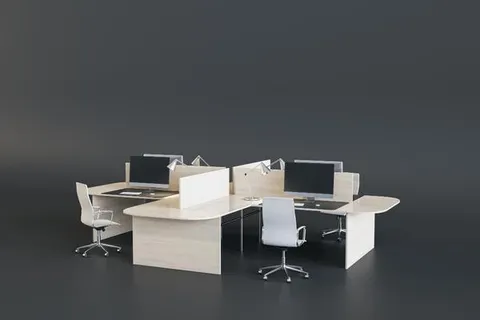
That should change what you buy. An open desk sharing workstation is a good base layout for a churning floor, but only if it is built for repeated assembly rather than for one perfect installation.
What breaks when furniture is moved
We see the same failures on second-hand and low-specification systems every time:
Stripped fixings. Screws driven directly into particleboard hold once. On the third reassembly the thread is gone and the joint is loose forever. The fix is threaded metal inserts at every structural fixing point — a small cost at manufacture, decisive after two moves.
Non-reversible joints. Glued or dowelled joints in the structural frame cannot be undone without damage. Every structural connection on a system meant to move should be bolted.
Damaged edges. Panel corners take the impact when units are carried through doorways. Thicker edge banding, properly radiused, is the difference between furniture that looks tired after one move and furniture that does not.
Orphaned parts. After a reconfiguration there are always leftover brackets and missing ones. Systems with a small, consistent parts count survive this. Systems with twelve different bracket types do not.
Designing for reconfiguration
A few principles matter more than the rest:
- One grid dimension. If every worktop is a multiple of a single module, any unit can join any other unit. Bespoke one-off sizes stop being reusable the moment the room changes.
- Screens that clip, not bolt through. Screen brackets that clamp to the worktop edge allow pairs to be split, joined or re-handed without new holes.
- Services in a removable channel. A raceway with a lift-off lid can be rerouted. Cable trays fixed under a worktop with cable ties cannot.
- Levelling feet everywhere. A floor that was flat where the desk started will not be flat where it ends up.
Seat density and the coworking maths
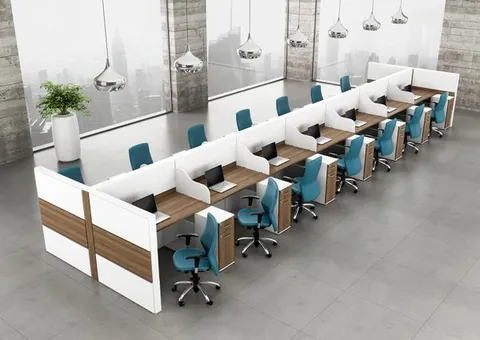
Sharing layouts are the standard for coworking because the per-seat depth is efficient — two working sides off one spine. A run of paired seats at 1200 mm pitch gives you predictable, saleable seat counts and lets an operator add or remove a seat pair without touching the rest of the row.
For a private team, the same property means growth does not require a redesign. You add a pair to the end of the row.
The one thing worth over-specifying
Worktop surface. In a high-churn floor, the desk surface takes the most visible wear — bags dragged across it, monitors repositioned, hot cups without coasters. A higher-grade laminate with a properly bonded 2 mm edge band adds relatively little to cost and is the single most visible difference between a floor that looks two years old and one that looks eight.
Talk to us about how often you expect to move
We build open desk sharing workstations at our own Bommanahalli workshop, and we will specify fixings and joints differently for a floor that reconfigures quarterly than for one that will not move. Call +91 98807 93666 or email info@srirangainterior.com.