Devanahalli
Open Desk Plus Type Workstations in Devanahalli: The Four-Seat Module
The plus-type cluster seats four off one structure and scales in fours. Module geometry and growth planning for offices in Devanahalli, Bengaluru.
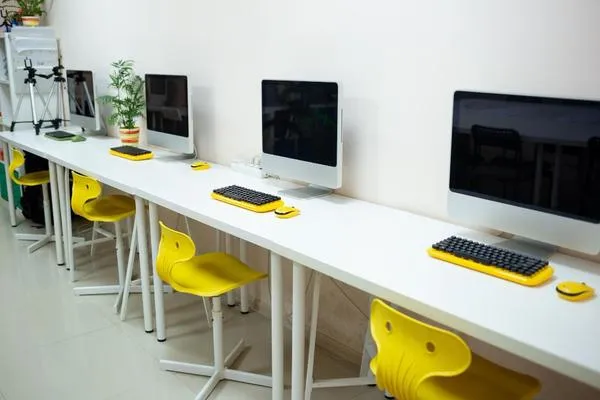
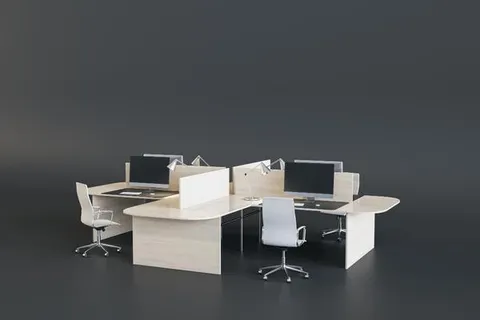
A plus-type workstation is four desks arranged around a central point, each occupying one arm of a cross. It is the most structurally efficient open desk cluster there is, and it happens to match the size of the smallest unit most organisations actually work in: a team of four.
Why four is the useful number
Team sizes cluster around four for reasons that have nothing to do with furniture. Four people can hold a single conversation without splitting into two. Four is a common project team, a common shift group, a common reporting unit. Above six, a group fragments; below three, it is not a team.
A plus-type module maps onto this exactly. The four users sit facing outward or inward depending on how the screens are set, but all four are within arm’s reach of the shared centre. There is no seat in the cluster that is far from the others.
Structural efficiency
The central junction of a plus takes the load from four worktops at once. That means one column of structure supports four seats, against four sets of legs for four independent desks. Materially, this is the leanest of the cluster geometries — fewer components, less steel, faster assembly.
It also concentrates services. One vertical riser at the centre feeds four positions. On a floor where the building delivers power at fixed points, one connection per four seats is a meaningful reduction in electrical work.
Growth in fours
The property around Devanahalli — the northern corridor around the airport — attracts businesses at very different stages, from aviation and logistics operations working to fixed headcount to newer ventures that genuinely do not know how large they will be in a year. For the second group, a modular cluster that scales in fixed increments is worth more than a bespoke layout that fits today perfectly.
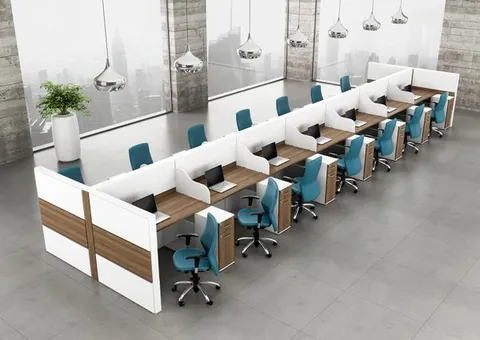
Adding a plus module to a floor is an additive operation: you place another cluster, run services to it, and the existing layout is untouched. Compare that with extending a continuous run of desks, where adding two seats can require repositioning everything downstream of the addition.
Planning practice we would suggest:
- Lay the floor out on a grid of plus modules, including positions you do not yet occupy
- Route the services spine past the empty positions from the start
- Keep the finish specification recorded so a module ordered in eighteen months matches
Where the plus does not work
Two situations. First, narrow plates: a plus module is roughly square, and a square module wastes floor in a plate under about 6 m deep. Use linear layouts there. Second, work needing screen privacy from colleagues — an inward-facing plus puts four screens visible to each other, and raising screens high enough to prevent that removes the point of the layout.
Getting the detail right
The centre junction is the piece to scrutinise. It carries four loads and is the point every cable passes through. We build it as a proper structural node with a services void through it, rather than as four worktops meeting at a shared leg.
Ask for a module layout
We manufacture plus-type open desk clusters at our Bommanahalli workshop and will lay your plate out in modules with a growth sequence marked. Call +91 98807 93666 or email info@srirangainterior.com.