Marathahalli
Modular High Partitions in Marathahalli: Acoustic Performance in Practice
What a high partition can and cannot do for noise, how absorption differs from blocking, and when to specify high partitions for Marathahalli offices.
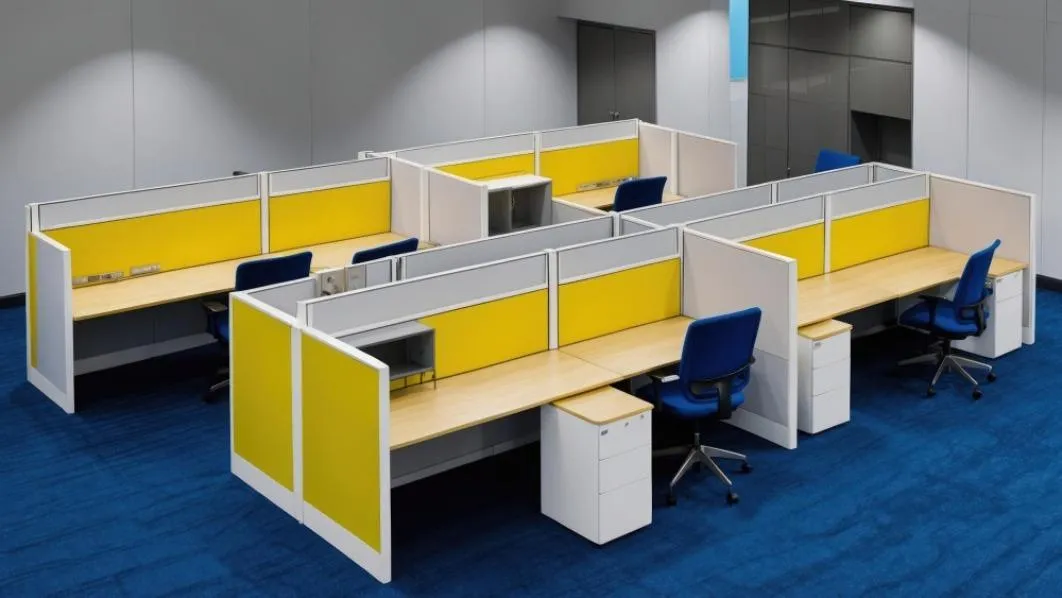
High partitions — 1500 mm and above — are usually bought to solve a noise problem. They can help substantially, but only if you understand what they are physically doing, because two partitions of identical height can produce entirely different acoustic results depending on their construction.
Blocking and absorbing are different things
Blocking means the partition interrupts the direct sound path between two people. This depends almost entirely on height and mass. A tall, heavy partition blocks; a tall, light one blocks less.
Absorbing means the partition surface converts sound energy rather than reflecting it. This depends on the face material and what is behind it. A fabric face over a porous core absorbs; a laminate face reflects.
An office full of tall, hard-faced partitions can be louder than one with no partitions at all, because every panel is a reflector adding to the reverberant field. If you are specifying high partitions for noise, absorption is not optional.
What determines the acoustic result
Height relative to the sound source. Speech originates at seated mouth height, around 1150 mm. A 1500 mm partition interrupts that path. A 1200 mm one barely does.
Mass. Sound transmission through a panel is governed largely by its weight per square metre. A hollow panel with thin skins transmits noticeably more than one with a dense core.
Face absorption. Fabric over acoustic infill absorbs mid and high frequencies — exactly the range that carries speech intelligibility. This is the single most cost-effective acoustic upgrade available on a partition.
Gaps. A gap at the floor, at a panel joint, or where a run meets a column is an acoustic bypass. Sound is a fluid; it finds every opening. Continuous, well-fitted runs perform; runs with gaps do not, regardless of panel specification.
The ceiling above. A high partition under a hard, reflective ceiling loses much of its benefit, because sound reflects off the ceiling and over the top. High partitions and an absorbent ceiling work together; either alone underperforms.
What high partitions genuinely deliver
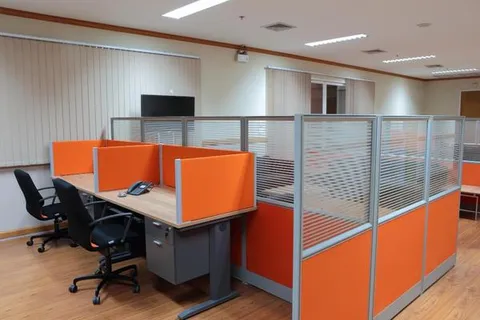
Realistically, a well-constructed 1650 mm partition with an absorptive face, in a room with a treated ceiling, will meaningfully reduce speech intelligibility between adjacent workstations. Someone two desks away will hear that you are talking but will struggle to follow what you are saying, and that is the threshold at which speech stops being distracting.
What it will not do is provide confidentiality. Anything genuinely confidential needs an enclosed room with a full-height wall, a sealed door and treatment above the ceiling. No open-plan partition, at any height, substitutes for that.
The costs of going high
Be clear about what you give up:
- Daylight penetration falls sharply. A floor of 1650 mm partitions is a dark floor unless glazed upper tiles are used.
- Supervision and sightlines disappear. Team leads cannot see their teams.
- The floor feels smaller and less connected.
- Reconfiguration is heavier work — tall panels are heavy and awkward.
Glazed upper tiles above 1350 mm recover most of the daylight while keeping the acoustic benefit, since the blocking is happening below seated head height anyway. On most floors this is the right compromise.
Marathahalli offices
The Marathahalli and ORR corridor holds a lot of process-driven operations — support centres, back-office and voice work — where multiple people speak simultaneously all day. This is the environment where high partitions are genuinely justified rather than merely traditional, and where the absorption specification is worth paying for.
Specify it as a system
Partitions, ceiling and floor finish work together acoustically. We manufacture modular high partitions at our own Bommanahalli workshop and will discuss the whole envelope rather than just the panel. Call +91 98807 93666 or email info@srirangainterior.com.