Kanakapura Road
ESD Workstation Manufacturer in Kanakapura Road — Choosing the Right Materials
Conductive, dissipative and insulative materials explained for ESD workstations on Kanakapura Road: laminates, mats, shelving, containers and what belongs at the bench.
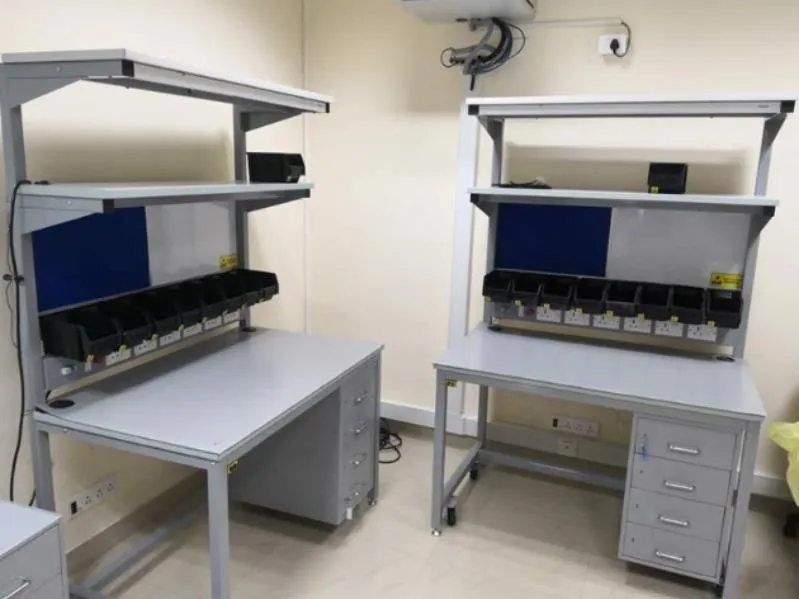
The most common misunderstanding about ESD control is that the goal is conductivity. It is not. The goal is a controlled rate of charge dissipation, and a fully conductive surface is as wrong as an insulating one — just wrong in the opposite direction.
Understanding the three material classes is what lets you specify a bench correctly rather than buying anything coloured green.
The three classes
Insulative. Charge does not move. A charge generated on the surface stays exactly where it was created and can discharge suddenly into a device. Ordinary laminate, painted steel, most plastics, cardboard and common packaging films are all insulative. This is the material class you are trying to remove from the bench.
Conductive. Charge moves freely and fast. Useful for grounding paths and for shielding containers, but a bare conductive worksurface is undesirable — a charged device placed on it discharges almost instantly, which is itself a damaging event.
Dissipative. Charge moves, but slowly and predictably. This is what a worksurface should be. A charged object placed on a dissipative top bleeds to ground over a controlled interval rather than in a spike.
The practical takeaway: the top is dissipative, the ground path is conductive, and nothing insulative belongs within reach of the work.
Specifying the bench materials
| Element | Material class | Notes |
|---|---|---|
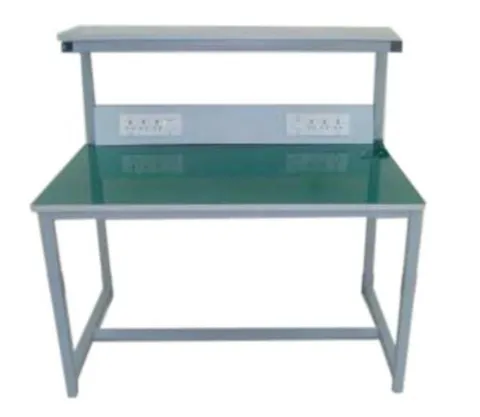
| Worksurface laminate | Dissipative | Sealed edges; ask for the surface resistance spec |
| Table mat | Dissipative | With its own ground cord; a consumable |
| Frame | Conductive, bonded | Powder coat is insulating — bond with an earth wire |
| Ground cord | Conductive with resistor | The resistor is a safety element, not optional |
| Shelving above bench | Dissipative or bonded conductive | Often overlooked |
| Bins and trays | Dissipative | Ordinary polypropylene bins are strong charge generators |
| Chair | Dissipative upholstery, conductive castors | The operator’s chair is part of the path |
That second-to-last row is where a lot of otherwise correct benches fail. A dissipative top loaded with ordinary plastic component bins puts a charge generator directly beside the work.
Sealed edges matter
A dissipative laminate is a surface treatment. If the board edge is exposed or banded with ordinary PVC, you have a strip of insulator running along the front of the bench exactly where the operator’s forearms rest.
Specify the edge treatment explicitly — either a dissipative edge band or a laminate wrap that carries the dissipative surface over the edge.
Testing and records
An ESD bench should be verifiable, not assumed. At handover ask for:
- The laminate manufacturer’s surface resistance specification
- A description of the grounding arrangement as built, including the common point ground location
- Point-to-ground resistance measured at each worksurface
Facilities running a documented ESD control programme will need these records for internal and customer audits. They are simple to produce during installation and awkward to reconstruct afterwards.
Built for the work, not just for compliance
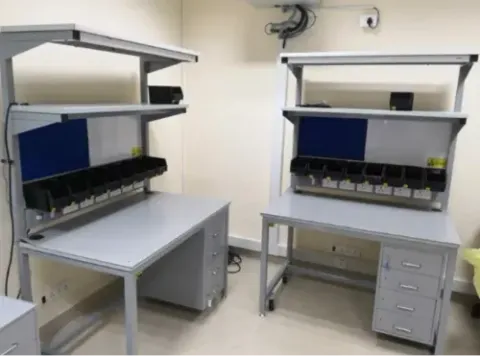
Beyond the electrical requirements, the bench still has to suit the task — depth for test equipment, correct height for seated or standing work, task lighting on the shelf rather than overhead, and a power raceway routed clear of the earth path.
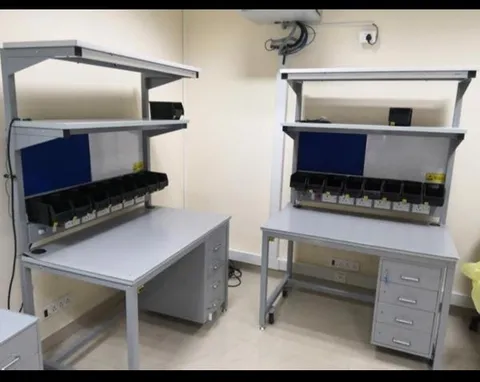
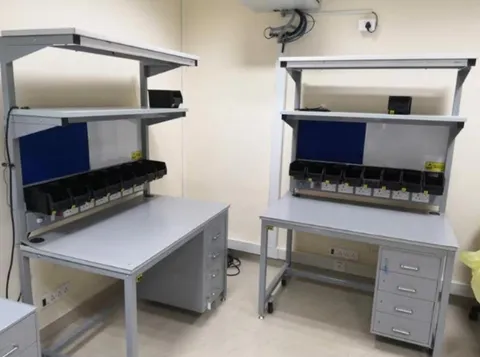
We manufacture ESD workstations at our own workshop at #336/10, Hosur Road, Bommanahalli, and install at electronics and testing facilities along Kanakapura Road.
Call +91 98807 93666 or email info@srirangainterior.com.