Hebbal
ESD Workstation Manufacture in Hebbal — Building a Grounded Bench
How an ESD workstation is actually grounded: dissipative laminate, grounding studs, common point ground, mats and wrist straps — for electronics facilities in Hebbal.
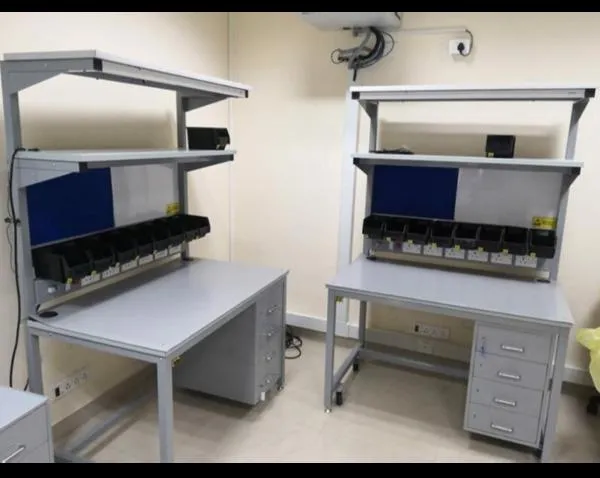
An ESD workstation is not a normal bench with a green top. It is an electrical path. Every conductive part of it — the worksurface, the frame, the operator, the tools, the shelf — has to reach earth through a controlled resistance. If any one of those connections is missing, the bench is decorative.
The path, element by element
The worksurface. A dissipative laminate, not an insulating one and not a bare conductor. The point of dissipative material is that charge bleeds away slowly and in a controlled way. A fully conductive top would discharge a device instantly, which can be as damaging as the static itself.
The grounding stud. Every ESD worksurface needs at least one, usually two, hard-fixed grounding points at the front edge. This is where the surface bonds to earth and where operator wrist straps plug in. A top with dissipative laminate and no stud is not grounded to anything.
The frame. MS or aluminium structure, powder-coated. Powder coating is an insulator, so the frame is bonded separately with an earth wire — not relying on metal-to-metal contact through painted joints.
The common point ground. All the bench’s earth connections gather at one terminal, which connects to the facility earth. A single point avoids ground loops between separate earth paths.
The operator. A wrist strap with a built-in resistor, plugged into the bench stud. In seated assembly work this is the primary operator path. Where operators move around, ESD footwear plus a dissipative floor takes over — but that is a facility decision, not a furniture one.
The mat. A dissipative table mat over the worksurface, with its own ground cord, is common where the top itself takes tool wear. It is a consumable; the laminate underneath is not.
What we build into the bench
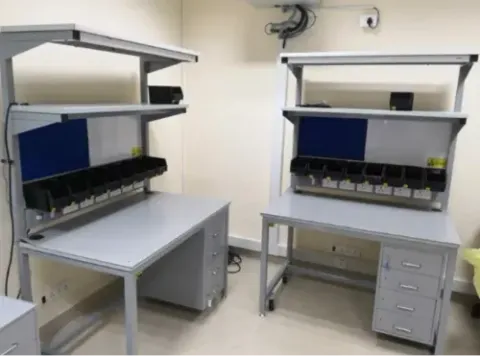
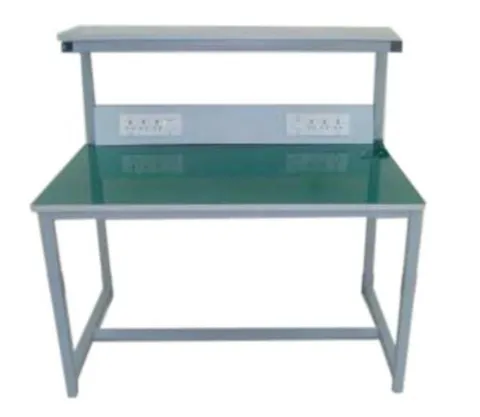
- Dissipative laminate worksurface with sealed edges
- Two front-edge grounding studs with banana sockets for wrist straps
- Earth-bonded frame with a labelled common point ground terminal
- Levellers on all legs, with an earth continuity path maintained
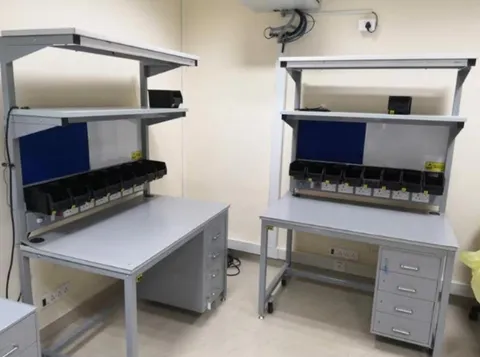
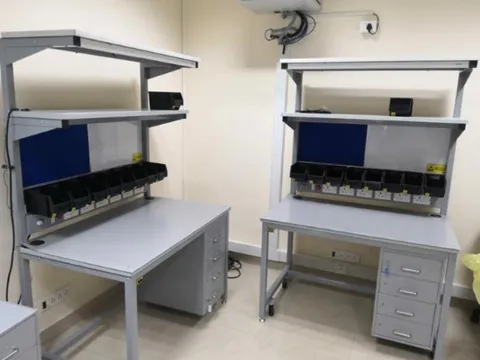
- Optional overhead shelf, tool rails and lighting, all bonded
- Cable raceway and switched power module, kept separate from the earth path
Layout on the shop floor
Once the electrical side is settled, the bench still has to fit the work. Points that come up constantly in electronics assembly and testing:
- Depth of 750-900 mm where test equipment sits on an overhead shelf and the operator still needs working room in front.
- Bench height depends on posture. Seated assembly work: 750 mm. Standing inspection or rework: 900-950 mm. Do not compromise between the two — pick per station.
- Task lighting on the shelf rather than relying on ceiling light, which the operator’s own head blocks.
- Continuous runs rather than islands, so the earth bus and power raceway run once along the row.
Documentation
Ask for the laminate’s surface resistance specification and a note of the grounding arrangement as-built. Facilities operating to an ESD control programme will need this for their own audits, and it is far easier to obtain at handover than two years later.
We manufacture ESD workstations at our own workshop at #336/10, Hosur Road, Bommanahalli, and install at electronics and testing facilities across Hebbal and north Bengaluru.
Call +91 98807 93666 or email info@srirangainterior.com.