BTM Layout
ESD Workstation Manufacturer in BTM Layout — Laying Out a Production Line
Bench layouts for electronics assembly and test lines in BTM Layout: station sequencing, bench heights for seated and standing work, WIP flow and shared services.
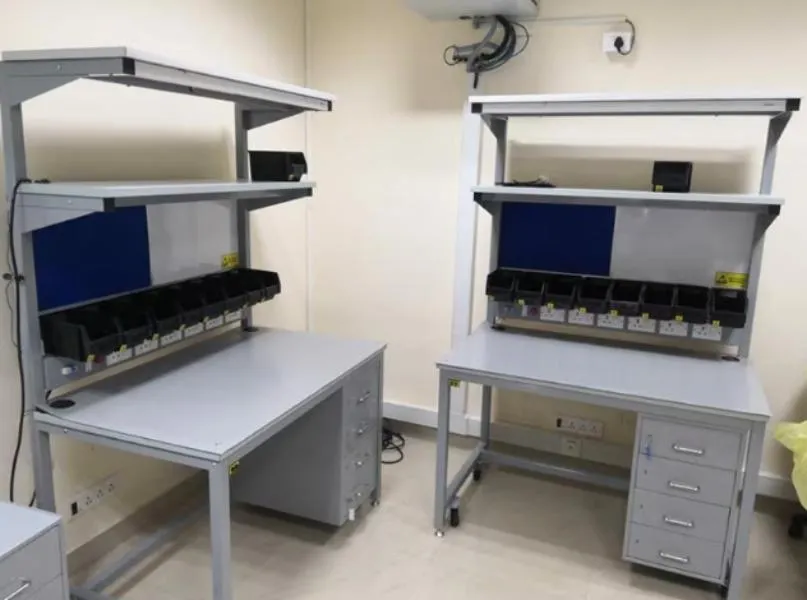
Static control is the part of an ESD workstation people focus on. Line layout is the part that determines whether the facility actually produces anything efficiently, and it is decided by the same set of benches.
If you are setting up or reorganising an electronics assembly, rework or test area, here is how the bench arrangement should follow the process.
Map the process before the furniture
List the operations in order — kitting, assembly, soldering, inspection, test, rework, packing — and for each one record:
- Seated or standing work
- Equipment that must sit on or above the bench
- Bench length required
- Whether work-in-progress arrives in trays, on a conveyor, or by hand
- Utilities needed: power, compressed air, extraction, network
This list produces the bench specification. Buying a uniform row of identical benches and then fitting the process to them is the common and expensive alternative.
Bench heights follow posture, not standardisation
| Operation | Bench height | Seating |
|---|---|---|
| Seated assembly, fine work | 750 mm | Task chair with footring |
| Seated inspection with microscope | 750 mm, adjustable preferred | Task chair |
| Standing test / rework | 900-950 mm | High stool with footring |
| Packing and dispatch | 900 mm | Standing |
Resist the pressure to make every bench the same height. A seated operator at a 900 mm bench works with raised shoulders all day, and a standing operator at 750 mm works bent over.
Depth against overhead equipment
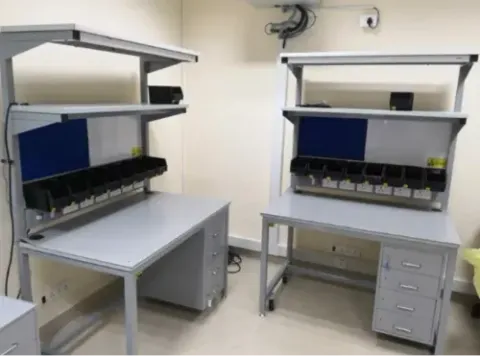
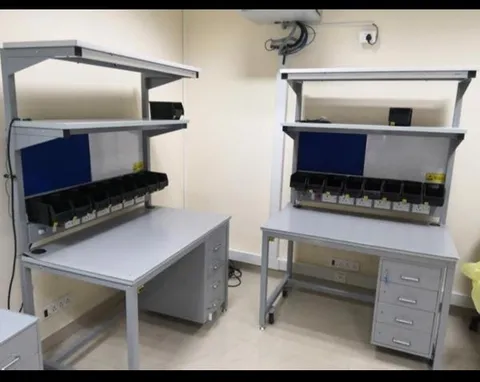
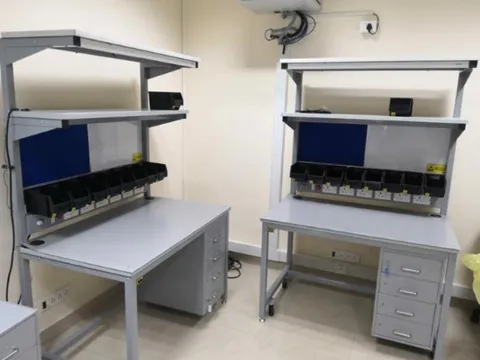
Where test instruments sit on an overhead shelf, the bench needs enough depth that the operator still has working room in front of them.
- 600 mm depth: bare bench, hand assembly only
- 750 mm: with a single shelf above
- 900 mm: with instruments on a shelf and a fixture on the bench
Overhead shelf height should clear the seated operator’s line of sight to the work — typically 400-500 mm above the bench top for a lower shelf.
Flow between stations
U-shaped cells work well for small teams: one operator can cover two or three adjacent stations, WIP travels short distances, and the cell has a single entry and exit point.
Straight lines suit longer processes with dedicated operators per station, and make conveyor or roller-track WIP transfer simple.
Whichever you choose, allow 1200 mm of aisle behind seated operators. Anything less and a trolley cannot pass behind someone who is working.
Where WIP lives
Every station needs a defined inbound and outbound position for trays — usually at opposite ends of the bench, so work moves in one direction across the surface. Without this, trays accumulate in the middle and the working area shrinks.
Use dissipative bins and trays. Ordinary polypropylene containers are strong charge generators and undo the bench they sit on.
Shared services
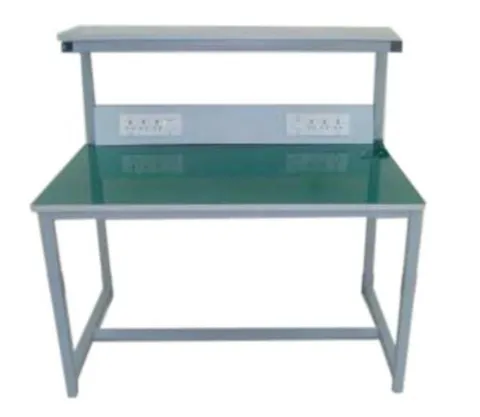
Route power, air and network along the bench line once, in a raceway, with drops at each station. Individual feeds per bench multiply floor boxes and make the line impossible to reconfigure.
Keep the ESD earth bus separate and clearly identified, gathered at a labelled common point ground.
Built to your process
We manufacture ESD workstations, overhead shelving, trolleys and bench-line storage at our own workshop at #336/10, Hosur Road, Bommanahalli, built to the station sizes your process actually needs.
For an electronics facility in BTM Layout, call +91 98807 93666 or email info@srirangainterior.com.