Bengaluru
What Static Damage Actually Costs Bengaluru Electronics Firms
Why electrostatic discharge damage is expensive and hard to detect, how latent failures reach customers, and what a properly specified ESD bench prevents in Bengaluru facilities.
The argument for ESD control is usually made in technical terms. The commercial argument is more persuasive, and it turns on one uncomfortable fact: most static damage does not show up at your facility.
Catastrophic versus latent failure
Catastrophic failure is the good outcome. The component is destroyed, it fails at test, you scrap it, and the cost is the component plus a little labour. Annoying, contained, visible.
Latent failure is the expensive one. The discharge weakens a junction without destroying it. The device passes every test you perform. It is assembled, shipped, and installed at a customer site — and it fails weeks or months later in the field.
Now the cost is not a component. It is a warranty claim, a field service visit, a returned unit, an investigation, and a customer who has formed an opinion about your reliability. For a contract manufacturer, it can mean a qualification audit.
Latent damage is invisible by definition, which is exactly why it is worth spending money to prevent something you will never see evidence of.
Where the charge comes from
Ordinary activity in an unprotected work area generates thousands of volts:
- A person walking across a synthetic floor
- Picking up or setting down a plastic bin or bag
- Sliding a board out of ordinary packaging
- Peeling adhesive tape
- Sitting down on and getting up from an untreated chair
Sensitive components can be damaged well below the threshold at which a person feels a shock. By the time you notice static, the level is far above what damages devices — meaning a work area can be causing damage continuously with no perceptible symptom.
What a properly specified bench provides
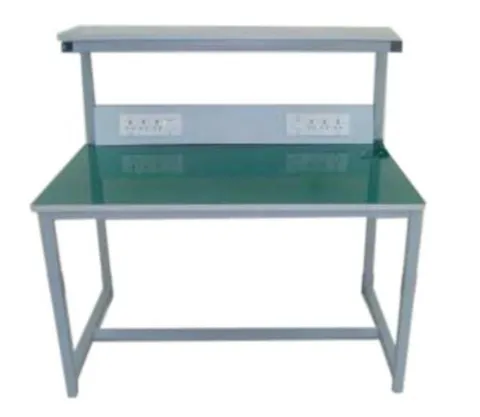
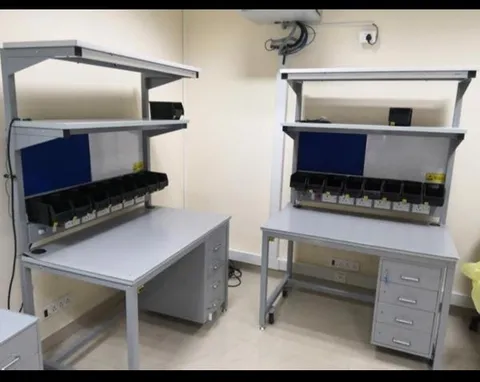
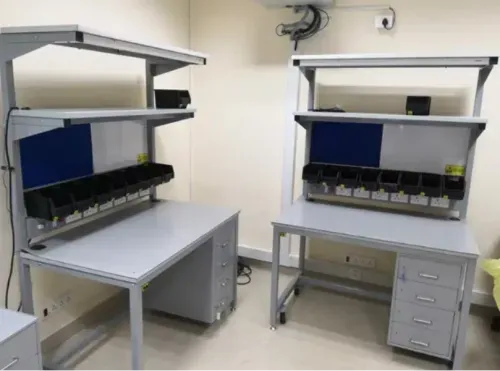
A correctly built bench — like the ESD workstations we manufacture — gives every conductive element a controlled path to earth:
- Dissipative worksurface laminate — charge bleeds away at a controlled rate rather than discharging in a spike
- Sealed dissipative edges — not an insulating PVC band where forearms rest
- Grounding studs at the front edge for operator wrist straps
- Earth-bonded frame, wired rather than relying on contact through powder coating
- A labelled common point ground so every path gathers at one terminal
- Bonded overhead shelving — often overlooked, and directly above the work
- Dissipative bins and trays, since ordinary polypropylene containers are strong charge generators
The parts that are not furniture
A bench is one element of an ESD control programme. The rest — dissipative flooring, ESD footwear, operator training, wrist strap testing, packaging materials, and periodic verification — is a facility decision.
Buying benches without the rest gets you part of the benefit. Worth knowing when planning, so the furniture budget is not mistaken for the whole solution.
Ask for the documentation
At handover, ask for the laminate’s surface resistance specification, a description of the grounding arrangement as built, and point-to-ground resistance measured at each surface. Facilities running a documented ESD programme need these for internal and customer audits, and they are far easier to produce during installation than years afterwards.
Built for Bengaluru’s electronics sector
We manufacture ESD workstations, bench-line shelving, trolleys and storage at our own workshop at #336/10, Hosur Road, near ICICI Bank, Bommanahalli, Bengaluru 560068, built to the station heights, depths and equipment loads your process actually needs.
Call +91 98807 93666 or email info@srirangainterior.com.