Uttarahalli
Commercial Workstation Manufacturer in Uttarahalli — Storage That Keeps Desks Clear
Pedestals, overhead units, lockers and credenzas compared for Uttarahalli offices — how much storage each seat really needs and where to put it without losing floor area.
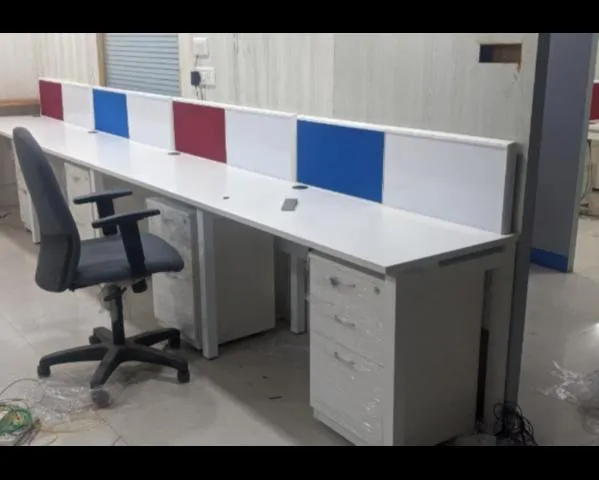
A cluttered office is almost always a storage-planning problem. Things end up on desks because there is no correct place for them, and no amount of tidying policy fixes a missing shelf.
The right question is not “how much storage should we buy” but “what is being stored, and how often is it retrieved?” Retrieval frequency decides where it goes.
Sort by retrieval frequency
| Frequency | Where it belongs |
|---|---|
| Several times a day | Desk drawer, within arm’s reach |
| Daily | Mobile pedestal under or beside the desk |
| Weekly | Shared credenza within the team area |
| Monthly | Filing run along a wall |
| Yearly / archival | Off the working floor entirely |
The mistake most offices make is putting monthly and archival material in per-seat storage. That is the most expensive storage in the building — it occupies prime floorplate — and it is being used for boxes nobody opens.
What each seat actually needs
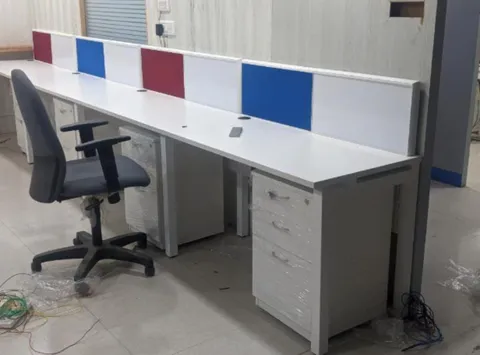
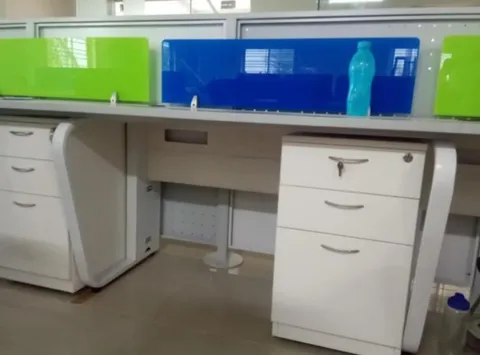
Three-drawer mobile pedestal. Two shallow drawers for stationery and personal items, one file drawer at the bottom. This covers daily needs for the great majority of roles.
Specify: ball-bearing full-extension slides, a lock on at least one drawer, and twin-wheel castors. The file drawer must extend fully — a hanging file at the back of a partially-extending drawer is unreachable, which means the back third of the drawer is wasted.
Personal locker. Underrated and cheap. Somewhere for a bag, helmet, lunch box and jacket. Without it, all of that goes under the desk and the floor cannot be cleaned. A run of lockers along a wall serves 40 people in about 3 metres.
Where not to put storage
Overhead units on low screens. Overheads only work on screens 1350 mm and above. On a 1200 mm screen the unit hangs in the sightline and makes the whole floor feel enclosed.
Deep credenzas in the middle of the floor. A 450 mm-deep unit against a wall costs nothing in usable floor area. The same unit standing free in the floorplate costs its depth plus access on both sides.
Under the desk, beside the pedestal. A second unit under a desk kills the knee zone. One pedestal per seat, offset to one side, leaves clear leg room on the other.
Shared storage sizing
For a team of six, a shared credenza run of 1800-2400 mm along the nearest wall typically covers weekly-access material: forms, samples, printed references, spare stationery.
Divide it as a mix of drawers, shutter cupboards and one open bay. The open bay always fills first, because people prefer storage they can see into.
The print and consumables station
Every office needs one and few plan for one. A dedicated 900-1200 mm unit with paper storage below and the printer on top, positioned away from desks. Without it, the printer sits on a desk that then cannot be used, and paper reams stack on the floor beside it.
Archival material
Records that must be kept but are rarely retrieved should leave the working floor. Options: a dedicated store room, high-density shelving in a service area, or off-site. Anything else means paying prime rent per square foot to store paper.
We manufacture pedestals, credenzas, lockers, filing units and print stations along with workstation systems at our own workshop at #336/10, Hosur Road, Bommanahalli, so storage matches the desks rather than being sourced separately.
Call +91 98807 93666 or email info@srirangainterior.com for offices in Uttarahalli.