Bengaluru
What a Bengaluru Office Worksurface Is Made Of
A materials guide to office table tops in Bengaluru: board substrates, laminate grades, post-forming, edge banding and how each choice affects durability and cost.
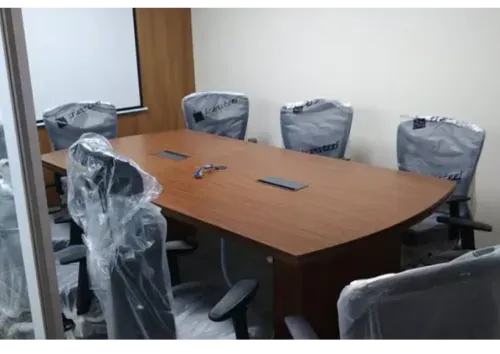
A worksurface is three things stacked together: a board, a decorative layer, and an edge. Each is specified separately, and the combination determines whether a desk still looks right in year five.
The board
Pre-laminated particle board. Chips bonded with resin, supplied with laminate already applied. The default for office worksurfaces and entirely adequate in a dry office. Moderate screw holding; poor moisture resistance once the core is breached.
MDF. Homogeneous fibre board with no grain. Machines beautifully, so it is the right substrate for any profiled or post-formed edge. Similar moisture behaviour to particle board unless the MR grade is specified.
HDHMR. Denser, better screw holding, noticeably better moisture resistance. Worth the step up for pantry counters and heavily-used surfaces.
Plywood. Best strength-to-weight and best screw holding. Spans further without sagging, which matters on a 1800 mm top with only end supports. The right choice for any surface near water.
Thickness: 25 mm for worksurfaces. 18 mm is used to save cost and visibly deflects on spans over about 1200 mm with a load in the middle. If a quote does not state thickness, ask.
The decorative layer
High-pressure laminate (HPL). Sheets of resin-impregnated paper pressed at high pressure, then bonded to the board. Available in a wide range of finishes and the most durable option per rupee. This is what most commercial worksurfaces use.
Low-pressure laminate (LPL / pre-lam). The decorative paper is fused directly to the board during manufacture. Thinner and less abrasion-resistant than HPL, but cheaper and perfectly serviceable on vertical surfaces and light-duty tops.
Veneer. Real wood, so it looks and ages like wood. Requires a protective coat, marks more easily, and can be refinished — which laminate cannot.
PU paint. The best appearance and the only finish that can be locally repaired. Highest cost, and it scratches more easily than laminate.
For a desk that gets written on, wiped daily and knocked by chair arms, HPL in a matt or lightly textured finish is the practical answer almost every time.
The edge
This is where worksurfaces fail, and it is the cheapest thing to get right.
2 mm PVC edge band, machine-pressed. The adhesive is applied at controlled temperature by an edge bander and trimmed flush. The bond does not lift.
0.8 mm band or paper edging. Costs less. Chips at the corners within a year or two, and once a corner lifts, moisture enters the board core and the swelling is permanent.
Post-formed edge. The laminate wraps continuously over a rolled front edge with no joint at all. There is nowhere for water to enter. Ideal for pantry, canteen and reception surfaces that get wiped constantly. It requires an MDF substrate and adds cost.
Band all four edges, including the back. The back edge is routinely skipped to save a small amount, and it is exactly the edge sitting against a wall where moisture collects.
Balance the panel
Both faces of a worksurface need a laminate or a balancing layer. A top laminated on the visible face only will bow, because the two faces respond differently to humidity. This is not optional and it is not visible until it happens.
Put it in writing
Board type, thickness, laminate type and code, edge band material and thickness — four lines that make quotes comparable and make a repair possible years later.
We manufacture office tables and worksurfaces — alongside the rest of the office furniture we build — at our own workshop at #336/10, Hosur Road, Bommanahalli, Bengaluru 560068, and record the specification against every project.
Call +91 98807 93666 or email info@srirangainterior.com.