Bannerghatta
Under Table Drawers in Bannerghatta: Retrofitting Storage to Existing Desks
Adding drawers to desks you already own. The clearances to measure first, fixing methods and where a retrofit will not work. For Bannerghatta offices.
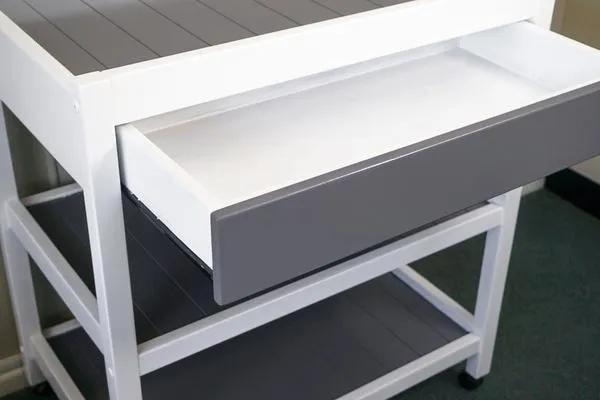
Most enquiries about under table drawers are retrofit enquiries. The desks are already in place, they have no storage, and buying new desks to solve a drawer problem is not sensible. A suspended drawer fixed to the underside of an existing worktop is the right answer — provided you measure four things first.
Get any of them wrong and the drawer either will not fit or will make the desk unusable.
Measure these before ordering
1. Clear height under the worktop. Measure from the floor to the underside of the top, then subtract for any rail, apron or frame member running under the desk. This is your available height, and it is usually less than people assume.
2. Knee clearance you must preserve. A seated person needs at least 650 mm of clear height under the desk at the knee, and 600 mm of clear width. Whatever drawer you fit must not intrude into that zone. This is why under table drawers are almost always fitted to one side rather than centrally.
3. Depth from the front edge to any obstruction. Modesty panels, cable trays and structural rails all sit behind the front edge and limit drawer depth. Measure to the first obstruction, not to the back of the desk.
4. Worktop thickness and construction. The drawer will hang from this. An 18 mm particleboard top can take a light drawer; it cannot take a loaded file drawer without additional support. If the top is thin, the fixing has to go into the desk frame, not the board.
Types that suit a retrofit
Slim pencil drawer. 60–80 mm deep, full desk width or half width, fitted centrally under the front edge. Holds pens, small items, a notepad. Minimal intrusion into knee space if fitted right at the front edge, but it does reduce clear knee height by its own depth — check point 2 above.
Side-hung box drawer. A single drawer of 130–150 mm depth fitted to one side, away from the knee zone. The most useful retrofit for most desks.
Suspended two-drawer unit. Effectively a small pedestal hung from the top rather than standing on the floor. Keeps the floor clear for cleaning, which is genuinely useful, but requires a top and frame capable of carrying the load.
Under-desk CPU or equipment holder. Not storage exactly, but the same retrofit problem and the same measurements.
Fixing method
There are only two sound approaches. Either the drawer bracket screws into a solid desk frame member, or it fixes into the worktop with through-fixings and a spreader plate on the top surface. Screws into the underside of a particleboard top, with nothing spreading the load, will pull out — not immediately, but eventually, and usually while loaded.
If neither a frame member nor a through-fixing is possible, the retrofit is not viable and a mobile pedestal is the honest alternative.
When to stop and buy a pedestal instead
A retrofit is the right answer when floor space is genuinely constrained or when the desk needs to stay clear underneath for cleaning. It is the wrong answer when you need file storage — a hung drawer carrying suspended folders puts a load on an existing top that was never designed for it.
Bannerghatta offices
The Bannerghatta Road corridor has a lot of established offices working with furniture that is sound but under-specified — desks that have years of life left but were bought without storage. Retrofitting is a good deal for exactly this situation: it extends the life of usable furniture rather than replacing it.
Send us a photo and the measurements
We manufacture under table drawers to fit at our Bommanahalli workshop. Send a photo of the desk underside and the four measurements above to info@srirangainterior.com, or call +91 98807 93666 and we will visit and measure.