Banashankari
3in1 Drawer Pedestals in Banashankari: What Fits in Each Compartment
A three-compartment pedestal in one footprint. Compartment sizing, realistic capacity and where the format works best in Banashankari offices.
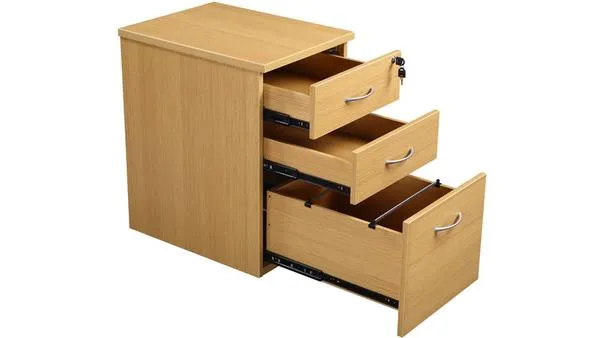
A 3in1 drawer pedestal puts three differently sized compartments into one unit occupying roughly 400 × 500 mm of floor. The appeal is obvious in a tight office. The question worth asking before ordering is whether three compartments in that footprint actually hold what you need, or whether you are buying three compartments that are each slightly too small.
Here is what the format realistically holds.
The three compartments
Top: shallow drawer, 80–130 mm internal. Pens, clips, cards, a phone, keys, a calculator, a small notepad. With a divider tray, this becomes genuinely organised. Without one, it becomes a single tray of loose items and stops being useful within a month. Specify the tray.
Middle: box drawer, 130–180 mm internal. A stack of A4 lying flat to about 150 sheets, a headset, a charger and cables, a small hard drive, a tape dispenser. Reasonably versatile, but note that flat-stacked paper here is retrieval-hostile — the lower sheets never get looked at again.
Bottom: file drawer, 280–320 mm internal. Suspended folders standing vertically. Roughly 350–400 mm of filing depending on unit depth, which is around 20–30 loaded folders. This is the compartment that does real work.
The footprint arithmetic
At roughly 400 mm wide and 500 mm deep, a 3in1 pedestal occupies 0.2 sq m. Compare that against the alternatives:
| Option | Footprint | Filing capacity |
|---|---|---|
| 3in1 pedestal | 0.20 sq m | ~0.35 m of files, plus two small drawers |
| Two-drawer filing cabinet | 0.25 sq m | ~0.70 m of files, no small storage |
| Low storage unit, 900 mm | 0.41 sq m | ~1.8 m on shelves |
The 3in1 does not win on capacity. It wins on having three access levels in the space of one, which is a different benefit — it suits a person, not a department.
Where the format works
Under a desk in a small cabin, where floor space genuinely does not allow anything else.
In a shared or hot-desk setting, where one compact lockable unit per person is more practical than a filing cabinet.
Beside a reception desk, where the mix of small items, consumables and records maps well onto three sizes.
In a home office, where the compact footprint and mixed compartments suit having exactly one storage unit.
Where it does not
If you have a genuine filing volume — more than about 30 folders per person — the 3in1 is the wrong product and no configuration of it will fix that. You need dedicated filing, and the pedestal should hold only what is active.
Details that decide whether it lasts
The middle drawer of a 3in1 tends to be the busiest, so slide quality there matters most. The bottom file drawer carries the most weight, so its slides need the highest rating. Manufacturers who fit identical slides to all three drawers have optimised for their own procurement, not for how the unit is used.
Also check the anti-tip interlock. A 400 mm wide unit with a loaded bottom file drawer fully extended has a real tipping moment, particularly on castors.
Banashankari offices
Office space in Banashankari often comes in smaller, well-established premises — professional practices, consultancies, service businesses — where floor area is genuinely constrained and where individual staff hold their own working files rather than everything sitting in a central registry. The 3in1 format suits that pattern precisely, which is why it is a common request in the area.
Ask for the internal dimensions
We manufacture 3in1 pedestals at our Bommanahalli workshop and will give you internal compartment dimensions rather than just the external size — the external size tells you nothing about what will fit. Call +91 98807 93666 or email info@srirangainterior.com.