JP Nagar
Pedestal Drawers in JP Nagar: What Fails, and How to Specify Around It
Slides, locks, edge banding and carcass joints are what fail on office pedestals. A maintenance-led buying guide for JP Nagar workplaces.
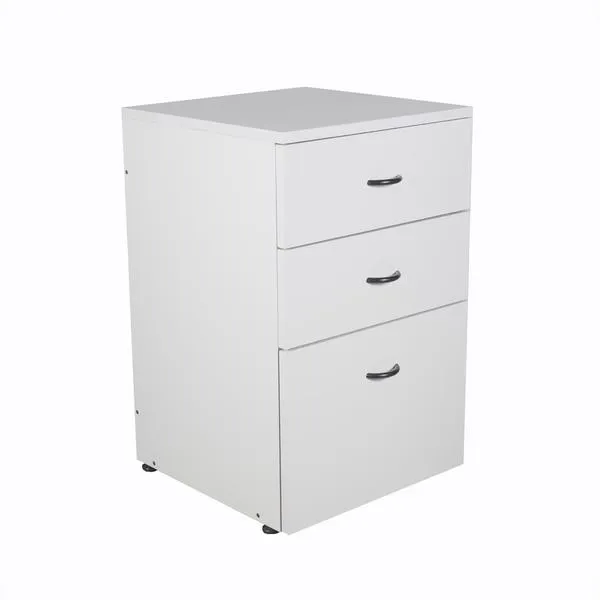
We repair and replace a lot of office furniture, and pedestal drawers fail in a small number of predictable ways. Knowing which ones lets you spend money where it prevents a failure rather than where it is merely visible.
Here is what actually breaks, in rough order of frequency.
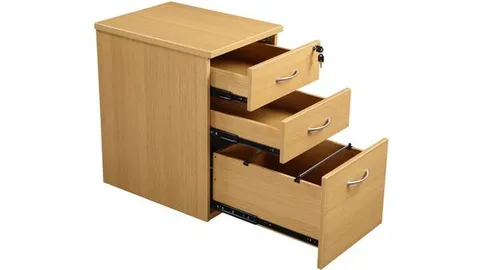
1. Drawer slides
By some distance the most common failure. Symptoms are a drawer that binds, drops at the front, or comes off its track entirely.
The cause is almost always a slide under-rated for the load it carries. A file drawer with suspended folders can easily hold 25 kg; light roller slides rated for 15 kg will fail within two years of daily use, and the failure is progressive — first stiff, then noisy, then jammed.
Specify around it: full-extension ball-bearing slides with a stated load rating comfortably above the realistic contents weight. This is the single most worthwhile upgrade in the whole unit.
2. The lock
Second most common. Cheap wafer locks wear, and the cam bends if the drawer is forced while locked. Once the cam is bent, the unit either will not lock or will not unlock.
Specify around it: a central locking bar operating all drawers from one cylinder, with a replaceable cylinder and recorded key numbers. Replaceable is the important word — a lock pressed into a panel and not designed to come out means the whole drawer front gets replaced.
3. Edge banding at the drawer front
Pedestals sit at foot level and get kicked, bumped by chair bases, and knocked by cleaning equipment. The bottom edge of the lowest drawer front takes most of it, and thin edge banding lifts there first. Once it lifts, moisture from floor cleaning gets into the board core and the corner swells.
Specify around it: 2 mm edge band on all exposed edges, PUR-glued where budget allows, and a slight setback of the lowest drawer front from the plinth line.
4. Carcass racking
A pedestal is a tall, narrow box. If it is joined only by screws into the board with no back panel doing structural work, it slowly racks out of square. Once it is out of square, the drawers bind regardless of slide quality — which is why a slide replacement sometimes does not fix the problem.
Specify around it: a full back panel let into a groove, not pinned onto the rear edge, plus metal-to-metal fixings at the structural corners.
5. Castors
On mobile units, castors are the cheapest component and often the first to be economised. A castor stem that works loose in a particleboard base cannot be tightened.
Specify around it: castors with a plate fixing into a reinforced base, not a stem pushed into a drilled hole.
The economics
The cumulative cost of these upgrades on a pedestal is modest — meaningfully less than the labour of a service visit, and far less than replacing units at year three. Because we manufacture rather than resell, we can specify the hardware line by line rather than offering whatever is in a fixed product spec.
JP Nagar offices
JP Nagar holds a lot of established small and mid-sized businesses that keep furniture for a long time rather than refitting on a lease cycle. That makes the calculation above much more favourable — if the furniture is expected to last eight years rather than three, hardware specification stops being a marginal decision and becomes the main one.
Ask what the hardware is
We will state slide type and rating, lock type, edge band thickness and carcass construction on any quotation. Call +91 98807 93666 or email info@srirangainterior.com, or visit the workshop at #336/10, Hosur Road, near ICICI Bank, Bommanahalli.