Basavanagudi
Office Cabin Tables in Basavanagudi: Power and Storage Integration
Where power enters a cabin table, how storage integrates, and what to plan in older buildings with no floor boxes. Cabin tables made to measure in Bengaluru.
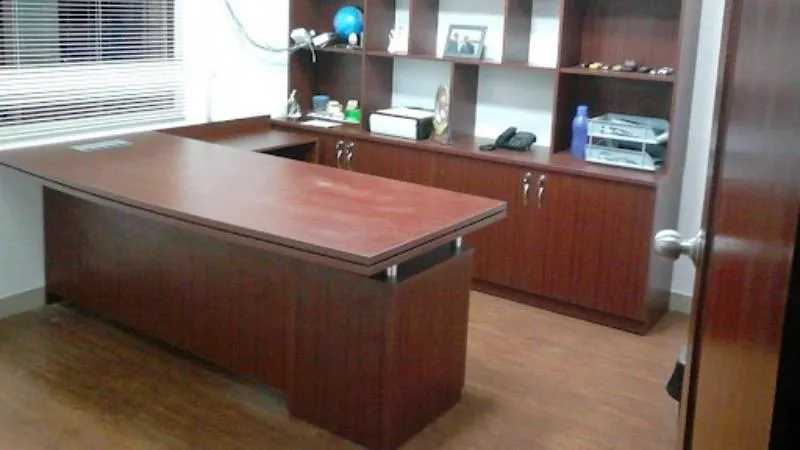
A cabin table is the most visible piece of furniture in a private office, so it gets specified on appearance. The two things that determine whether it is pleasant to use every day are less visible: where the power comes up, and how the storage relates to the seated position.
Both have to be decided before manufacture. Neither can be fixed afterwards without cutting into a finished piece.
The power problem in a private cabin
A cabin table needs power for a monitor, a laptop, a desk lamp, a phone charger, and usually a printer nearby. In a modern building with a raised floor and floor boxes, this is straightforward — the box sits under the table and cables come up through a grommet.
In older buildings, and in cabins created by partitioning an existing floor, there is often no floor box anywhere near where the table should stand. That leaves three options:
Route down a leg to a skirting outlet. The table needs an internal cable route from the worktop to the floor, concealed within a leg or a panel end. This has to be built in; you cannot add a concealed route to a finished leg.
Bring power along the wall to a table set against it. Constrains the table position to a wall, which conflicts with most cabin layouts.
Surface trunking across the floor. The default when nothing was planned, and it is both a trip hazard and immediately visible in a room meant to look considered.
The first option is almost always right, and it is a five-minute decision at the drawing stage.
Delivering power at the surface
Flip box recessed into the worktop — the tidiest, requires a machined cut-out.
A grommet with a socket unit beneath — simpler, cables visible at the grommet.
An under-edge socket strip — easy, but users grope beneath the table for it.
For a cabin table where the visitor side is seen, a flip box on the occupant’s side keeps the visible surface clean. Cut-out position should be set against where the monitor and laptop will actually sit, which means asking the occupant rather than guessing.
Storage relative to the seated position
Storage in a cabin table is either integrated or separate, and the choice has consequences.
Integrated pedestal, built into the table. Neat, matched, and permanently fixed. It also permanently occupies one side of the knee space. Only acceptable if the table is wide enough that clear knee space remains — a 1500 mm table with a 400 mm integrated pedestal leaves 1100 mm, which is fine; a 1200 mm table leaves 800 mm, which is tight.
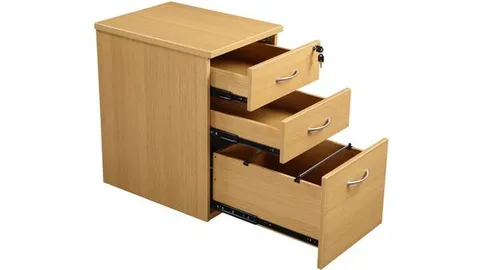
Mobile pedestal. Repositionable, removable, and it can be pulled out to act as a side surface. Less visually integrated. Generally the better choice.
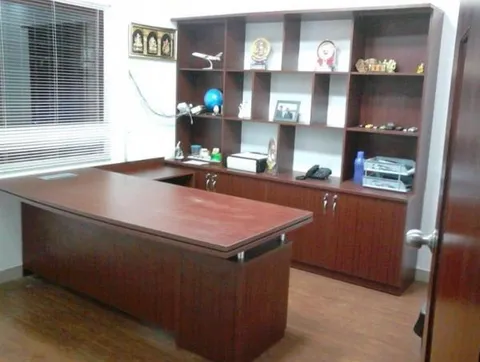
Side unit at table height. Forms a short return, adds working surface, keeps knee space entirely clear. The best option where the room allows it.
Credenza behind. Discussed elsewhere; needs 1000 mm of rear clearance plus its own depth.
Whichever is chosen, the same rule applies: nothing should intrude into a 600 mm wide, 650 mm high clear knee zone directly in front of the chair.
Older buildings in Basavanagudi
Basavanagudi has a substantial stock of older commercial and converted buildings — good proportions, high ceilings, and electrical installations that were not planned for a modern desk load. Cabins there frequently have one or two sockets on a wall and nothing in the floor.
That makes cable routing a design input rather than an afterthought. When we survey a cabin in this kind of building, we record where the existing outlets are before setting the table position, so the route from the worktop to a socket is short, concealed and does not cross a walking line. It is a small piece of planning that determines whether the finished room looks resolved or improvised.
Tell us where the sockets are
Send a photo of the cabin showing the existing outlets, along with the room dimensions. We manufacture cabin tables with concealed cable routes built in, at our own workshop in Bommanahalli. Call +91 98807 93666 or email info@srirangainterior.com.