Marathahalli
M.D. Tables in Marathahalli: What Bespoke Manufacturing Actually Involves
From brief to installation: the process behind a made-to-order M.D. table, what drives lead time, and where quality is decided. Built in Bengaluru.
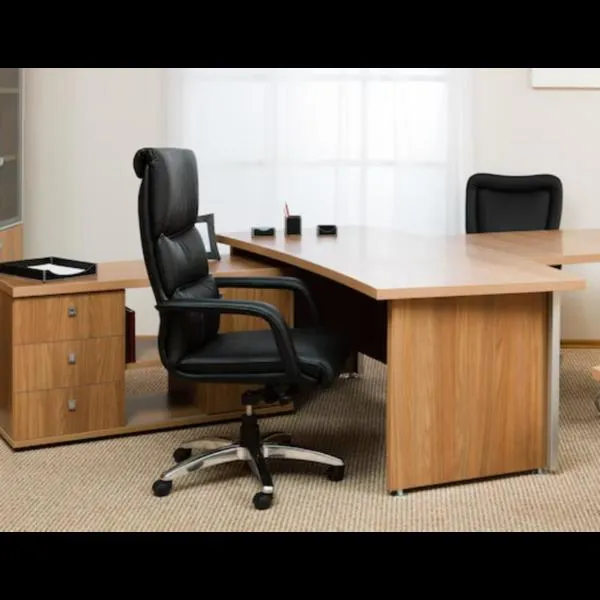
An M.D. table is usually the one piece in an office that is genuinely made to order. Everything else can be specified from a range; this one tends to be drawn for the room. That means the process matters as much as the design, because on a one-off piece there is no second unit to learn from — it has to be right the first time.
Here is how a bespoke table is actually made, and where each stage can go wrong.
1. Brief and site measurement
The measurement is not just the room. We record the internal dimensions, the door position and swing, window and beam positions, the floor level across the room, and where power and data enter. Floors in commercial buildings are rarely level; a 15 mm fall across 3 m is common and determines whether the table needs adjustable feet.
Where it goes wrong: measuring from an architect’s drawing rather than the built room. Built dimensions differ from drawn ones surprisingly often.
2. Design and drawing
The table is drawn in plan, elevation and section, with the storage, cable routing and joint positions shown. This is the stage where the client should be asked awkward questions: does anyone sit opposite? Is there a printer? Does the occupant use a laptop, a desktop, or both? Where does the visitor’s line of sight fall?
Where it goes wrong: signing off on a rendering rather than a dimensioned drawing. A rendering hides the section, and the section is where the knee clearance and the cable route live.
3. Material selection and sampling
Board core, finish, edge treatment and hardware are fixed here. On veneer work, this is when leaves are selected and sequenced so that grain runs continuously across adjacent panels. On a large top, this is also when the joint position is decided.
Where it goes wrong: approving a 100 mm finish chip. On a 2.4 m table, a small sample tells you very little about how a grain or a texture reads at full size.
4. Production
Cutting, edge banding, machining of cut-outs and grommets, assembly of the carcass and storage elements, and finishing. Everything is dry-assembled at the workshop before it leaves, so that any fit problem is discovered on our floor rather than in your cabin.
Where it goes wrong: skipping the trial assembly. A table delivered as components and first assembled on site is a gamble.
5. Delivery and installation
Access is checked before production, not after. A 2.4 m one-piece top that cannot enter the lift is a manufacturing problem, so any necessary joint is designed in at the drawing stage and placed where it will not be seen.
What drives lead time
- Finish availability. A stocked laminate ships immediately; a specific veneer or an imported finish adds weeks.
- Hardware. Soft-close slides, cable boxes and locks in a specific finish may need ordering in.
- Approval turnaround. In practice, waiting for sign-off is often the longest single item, and it is entirely within the client’s control.
- Complexity. Curved fronts, mitred edges and inlay work take substantially longer than rectilinear construction.
Marathahalli and access
Marathahalli and the ORR stretch around it hold a large number of leased office floors in multi-tenant buildings, where goods lift dimensions and permitted working hours are set by building management. We ask for those constraints at the measurement stage because they can change the joint design.
Start with a drawing, not a price
We manufacture M.D. tables at our own workshop at #336/10, Hosur Road, Bommanahalli. Call +91 98807 93666 or email info@srirangainterior.com and we will measure the room and draw the piece before quoting it.