Old Airport Road
Glass Discussion Tables in Old Airport Road: Specifying Glass Correctly
Toughened glass thickness, edge treatment, support spacing and safety for glass discussion tables. What to specify for Old Airport Road offices.
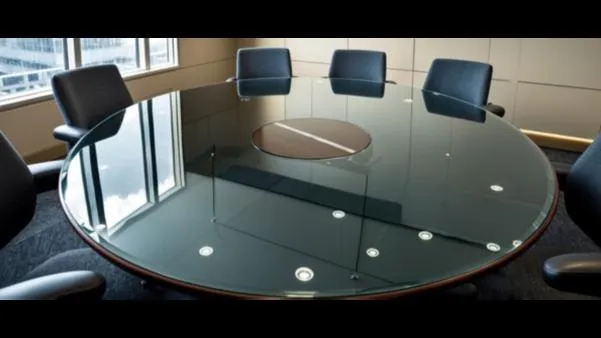
Glass is the one office furniture material where getting the specification wrong has a safety consequence rather than just an aesthetic one. A glass tabletop is a large horizontal pane at torso height in a room people move around quickly. It needs to be specified properly, and the specification is not complicated once you know what the variables are.
Toughened, always
Ordinary annealed glass breaks into large, sharp shards. Toughened (tempered) glass is heat-treated so that it is several times stronger and, critically, fragments into small blunt pieces when it does break. There is no acceptable use of annealed glass for a tabletop.
Toughening must happen before any cutting or drilling — a toughened pane cannot be worked afterwards. This means every dimension, every hole and every cut-out must be final before the glass is processed. It is the reason a change to a glass table after ordering means a new pane rather than a modification.
Thickness by span
Thickness follows the unsupported span, not the overall size.
| Unsupported span | Minimum thickness |
|---|---|
| Up to 900 mm | 10 mm |
| 900–1400 mm | 12 mm |
| 1400–1800 mm | 15 mm |
| Above 1800 mm | 19 mm, or additional support |
Under-thickness glass on a long span will not usually break, but it will flex visibly when someone leans on it, and that flex is unnerving enough that people stop using the table.
Edge treatment
The cut edge of glass is sharp and, more importantly, is where impact damage starts. Options:
- Ground / arrised — the minimum. Removes the cutting sharpness, leaves a matt edge
- Flat polished — smooth, clear, the standard commercial choice
- Bevelled — decorative chamfer, catches light, more expensive
- Pencil round — softened profile, the most impact-tolerant
For a table people brush past, pencil round or polished with a generous arris is the right answer. Corners should always be radiused, never left square.
Support and the base
Glass has no bending tolerance and it does not forgive a point load. That means:
Never glass directly on metal. Every contact point needs a resilient pad — rubber, PVC or felt. Glass on bare steel will chip at the contact point and the chip becomes a crack.
Support must be level and coplanar. Four support points that are not in the same plane will rock the pane and concentrate stress on two of them. Adjustable feet are effectively mandatory.
The base has to be heavier than it looks. Glass is visually light, so people assume it is physically light — a 12 mm pane at 1200 × 800 mm weighs roughly 29 kg. The base must resist tipping if someone sits on the edge.
Living with glass
Glass shows everything: fingerprints, dust, cup rings, and the underside of anything on it. Frosted or acid-etched surfaces hide fingerprints far better than clear glass and diffuse reflections. Back-painted glass gives a solid colour and hides everything below the surface entirely.
In practical terms, a clear glass table needs wiping daily. Offices that find that unrealistic should choose frosted or a back-painted finish rather than living with a permanently marked table.
Old Airport Road buildings
The corporate buildings along Old Airport Road often have well-lit, glazed meeting rooms. Clear glass in a strongly daylit room produces reflections off the tabletop that make screens and documents hard to read from certain seats. Frosted or lightly tinted glass avoids this without losing the visual lightness.
Get it specified properly
We supply glass discussion tables with toughened glass, sized and edged to specification, on bases built at our own Bommanahalli workshop. Call +91 98807 93666 or email info@srirangainterior.com.