Whitefield
Side Storage for Managers in Whitefield: Designing Around Reach Zones
What belongs within arm's reach and what does not. Ergonomic reach zones applied to manager side storage in Whitefield offices, built in Bengaluru.
Side storage in a manager’s cabin usually gets specified by volume — how many drawers, how many shelves. That is the wrong variable. The useful question is which items need to be retrievable without standing up, and where those items therefore have to sit.
Ergonomists divide the space around a seated person into three zones, and once you apply them, the layout of a side unit designs itself.
The three reach zones
Zone 1 — primary, within about 400 mm. Reachable with the forearm only, elbow at the side. This is the desk surface immediately in front, and the top drawer of a side unit at desk height. Anything used many times an hour belongs here.
Zone 2 — secondary, 400–650 mm. Reachable by extending the arm without moving the torso. The rest of the desk, and the upper drawers of a side unit positioned alongside. Items used a few times a day.
Zone 3 — tertiary, beyond 650 mm. Requires leaning, turning or standing. Lower drawers, cupboards behind, anything on the far side of the desk. Items used weekly or less.
The failure mode in most cabins is that Zone 1 and 2 are occupied by things used monthly — a stack of old files, a box of business cards, a printer — while the items used constantly are in a drawer that requires standing.
What goes where
| Zone | Contents |
|---|---|
| Primary | Phone, notepad, pen, current file, keyboard |
| Secondary | Active files, stapler, calculator, chargers, headset |
| Tertiary | Reference files, stationery stock, printer paper, personal items |
| Elsewhere entirely | Archive, sample stock, seldom-used equipment |
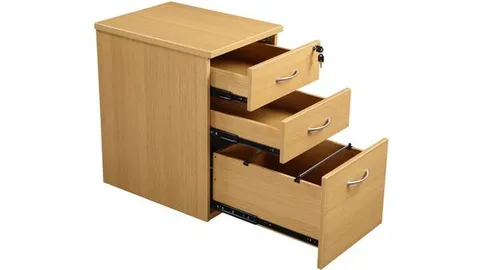
Applied to a side unit, this means the top one or two drawers should be shallow drawers for small frequently used items, the middle for active files, and the bottom for bulk. The commonest mistake is a unit of three identical deep drawers, which forces small items into a large space where they migrate to the back.
Position relative to the desk
Side storage can sit in three places, and the choice is consequential.
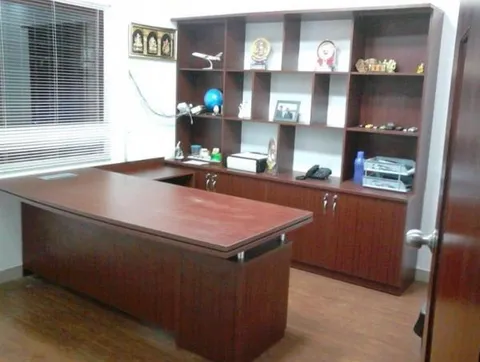
Flush alongside, at desk height. Effectively extends the desk. Best for active work. Requires that the unit top matches the desk top exactly — a 10 mm step is visible and annoying.
Behind, as a credenza. Keeps the desk clear and the visitor-facing side clean, but everything in it is Zone 3. Good for reference and stock, poor for anything active.
Under the desk, as a pedestal. Maximum accessibility, minimum capacity, and it competes with knee space. Only on the non-dominant side.
Most cabins want a pedestal plus a credenza, not one large side unit trying to do both jobs.
Locking and confidentiality
A manager’s storage generally holds something that should not be readable by anyone entering the cabin — appraisals, salary information, commercial documents. Specify at least one lockable drawer, and specify it in the unit, not as an afterthought. Retrofitting a lock to a drawer front is possible and always looks retrofitted.
Whitefield cabins
Whitefield’s office stock ranges from large campus buildings to smaller leased floors, and cabin sizes vary widely. Where a cabin is tight, a full credenza behind will not fit alongside the required 1000 mm rear clearance — in that case a taller, narrower side unit alongside the desk is the better use of the room.
Design it around the work
Tell us what the occupant does daily and we will lay out the drawer and shelf configuration to match. We manufacture side storage at our own workshop in Bommanahalli. Call +91 98807 93666 or email info@srirangainterior.com.