Mahadevapura
Pedestal Drawers in Mahadevapura: Getting the Configuration Right
Box, file and stationery drawer combinations explained, with internal fittings and capacity guidance for office pedestal drawers in Mahadevapura.
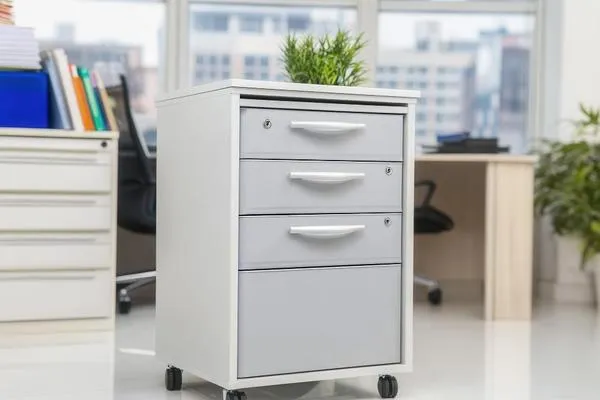
Every pedestal drawer unit contains the same total volume regardless of how it is divided. What changes with configuration is how much of that volume is usable — and the difference between a well-configured unit and a badly configured one is substantial, because the wrong drawer depth wastes space in a way that is invisible until the unit is in use.
The two basic drawer types
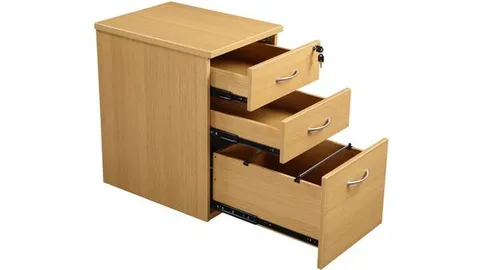
Box drawer. Around 130–160 mm internal depth. Holds stationery, small equipment, personal items, and papers lying flat. This is the drawer people open most often.
File drawer. Around 280–320 mm internal depth, fitted with rails for suspended files. Holds vertical filing, which is the only efficient way to store documents you need to retrieve individually.
A third variant, the stationery drawer, is a shallow box drawer at 80–100 mm with internal dividers, intended purely for pens, clips and small items.
Why depth matters more than it seems
Papers stored flat in a deep box drawer are a filing failure. To reach the bottom sheet you must lift everything above it, so in practice the lower two thirds of a deep flat-stacking drawer is dead volume within weeks. Everything settles into strata that nobody ever disturbs.
Vertical filing in a file drawer avoids this entirely — every folder is individually accessible from above. This is why the ratio of box to file drawers should follow how much document retrieval the role involves, not how much paper it holds.
Configurations by role
| Role | Configuration |
|---|---|
| Process / operations staff | 2 box + 1 file |
| Accounts, admin, HR | 1 box + 2 file |
| Technical / engineering | 3 box (little paper filing) |
| Executive | 1 stationery + 1 box + 1 file |
| Shared hot desk | 1 box + 1 lockable file, half height |
The default 2 box + 1 file exists because it suits the largest number of roles. It is a reasonable standard, but ordering it for everyone means the accounts team runs out of filing in month three.
Internal fittings worth specifying
- Suspended file rails in the file drawer, sized for the folder standard actually in use. Rails set for the wrong width are useless.
- A removable divider tray in the top box drawer. Without it, the top drawer becomes a single undifferentiated pile.
- A pen tray, ideally the sliding kind that leaves usable depth beneath it.
- Non-slip liner in the bottom drawer, so contents do not migrate every time it is opened.
These add very little to cost and change the daily experience of the unit considerably.
Height and the desk relationship
A pedestal intended to sit under a desk must clear the underside of the worktop and any rail. Check the actual clearance, not the nominal desk height — an 18 mm top on a 25 mm rail leaves less than the datasheet suggests.
A pedestal intended to sit beside a desk at desk height should match the worktop height exactly, so the top forms a continuation of the working surface. A 20 mm mismatch is visible from across the room.
Capacity, honestly
A standard file drawer holds roughly 350–400 mm of suspended filing. If your team’s paper volume is measured in cupboards, a pedestal is not the answer — pedestals are for active documents, and they work best when an archive policy exists to move things out of them.
Mahadevapura workplaces
The Mahadevapura corridor runs a lot of project-based technical work with relatively low physical filing. That argues for box-heavy configurations, and against buying the standard 2 box + 1 file for staff who will never put a suspended folder in it. It is worth asking the question rather than defaulting.
Ask for a configuration schedule
Tell us the roles and we will propose a drawer configuration per role rather than one specification for the whole order. We manufacture at our own Bommanahalli workshop. Call +91 98807 93666 or email info@srirangainterior.com.