Bangalore
Canteen Table Manufacturers in Bangalore — Sizing a Canteen That Actually Turns Over
Calculating canteen table capacity and seating turnover for Bangalore offices, plus table top materials, leg configurations and cleaning practicality for staff dining areas.
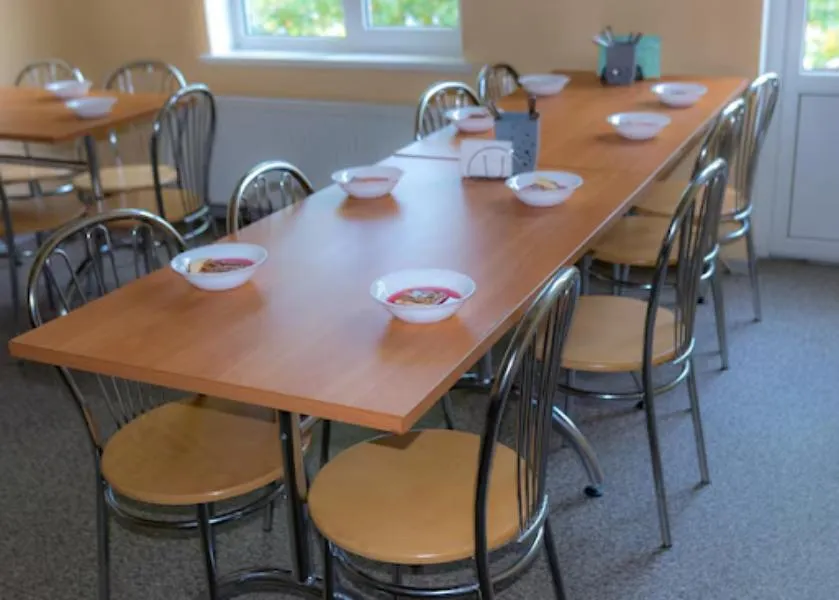
A canteen is a throughput problem disguised as a furniture problem. If 120 people take lunch between 1:00 and 2:00 p.m., you do not need 120 seats. You need enough seats that the queue at 1:15 does not stretch back to the pantry counter.
The capacity calculation
Average occupancy of a canteen seat during lunch is about 20-25 minutes. Over a 60-minute window, one seat serves roughly two and a half people.
So: seats required ≈ headcount ÷ 2.5, then add 15-20% because arrivals are not evenly distributed — the peak is usually the first twenty minutes.
For 120 staff: 120 ÷ 2.5 = 48 seats, plus 20% = around 58 seats. If the lunch window is shorter or staggered breaks are not enforced, that number rises quickly.
Table configuration against seat count
| Table type | Size | Seats | Area incl. circulation |
|---|---|---|---|
| Four-seater square | 750 × 750 mm | 4 | ~4.0 sq m |
| Six-seater rectangular | 1500 × 750 mm | 6 | ~5.5 sq m |
| Eight-seater bench run | 2000 × 800 mm | 8 | ~6.5 sq m |
| Two-seater | 600 × 600 mm | 2 | ~2.5 sq m |
Long bench-style runs give the highest seat count per square metre and are the right answer where the canteen is genuinely tight. Four-seaters use more area but people actually use all four seats — on a long bench, the middle positions go empty last.
A practical mix for most Bangalore corporate canteens is around 70% four- and six-seaters with one or two long runs.
Clearances that get skipped
- 750 mm behind a chair for the occupant to stand and leave
- 1100-1200 mm between the backs of chairs at adjacent tables where a person walks between them
- 1500 mm for the main circulation route to and from the serving counter
- Per person at the table: 600 mm of table edge minimum, 700 mm to be comfortable
Squeeze the second one and people carrying a full plate start squeezing sideways past seated colleagues, which is how spills happen.
Table tops for a canteen environment
A canteen top gets wiped a dozen times a day with a damp cloth, sometimes with a detergent, and takes hot vessels and dropped cutlery.
- Post-formed laminate on board with a rolled front edge — no edge joint for water to enter, which is the single biggest cause of canteen table failure.
- Stainless steel — indestructible and completely hygienic, though noisy and cold-looking. Suits industrial canteens more than corporate ones.
- Solid-surface or compact laminate — best resistance to water and heat, at higher cost.
Whatever the top, the underside and edges matter more than the face. Water gets into a canteen table from below, at the edge, where a wiping cloth pushes it.
Legs and bases
Four-leg frames are cheapest but every leg is somewhere a person wants to put their knee. A centre pedestal base on square tables or a cantilever/T-leg frame on rectangular tables frees up the seating positions and makes floor cleaning much faster — no mop dodging around sixteen legs per table.
Fix levellers on every leg. Canteen floors are wet-mopped daily and are rarely perfectly flat; a rocking table is the complaint you will hear most.
We manufacture canteen tables, benches, chairs and pantry storage at our own workshop at #336/10, Hosur Road, Bommanahalli. Call +91 98807 93666 or email info@srirangainterior.com.