Kanakapura Road
Canteen Storage on Kanakapura Road: Designing Around the Service Flow
Canteen storage should follow the path food takes from delivery to washing up. Layout, segregation and materials for canteen storage in Bengaluru offices.
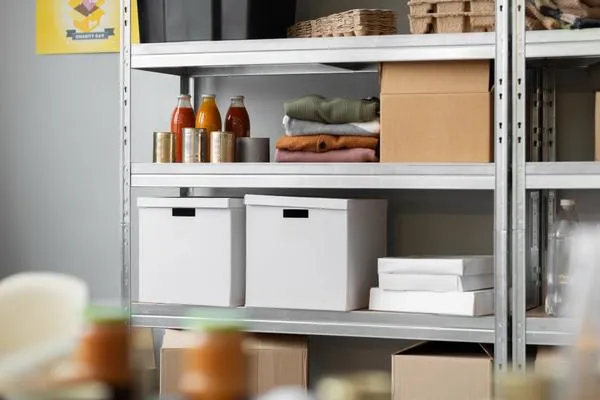
A canteen is different from a pantry in one important respect: food is served in volume, on a schedule, by staff. That makes it a process, and storage in a process environment should be positioned along the process rather than wherever there was wall space.
The flow to design around
Food and materials move through a canteen in a consistent sequence:
- Delivery arrives at a back door or service entrance
- Bulk storage — dry goods, disposables, held until needed
- Preparation or reheating — where portions are made ready
- Service — the counter where food is issued
- Dining
- Return — used crockery comes back
- Washing
- Clean storage — washed items held ready for the next service
- Waste leaves
Storage appears at four points in that sequence — bulk, service-adjacent, clean, and waste — and each one has different requirements. Putting one large storage unit somewhere and expecting it to serve all four means staff carry things back and forth across the room during every service.
Storage at each point
Bulk storage. Near the service entrance, so deliveries do not cross the dining area. Full height, adjustable shelves, sized for the delivery cycle — weekly delivery means a week’s stock must fit. Raised off the floor for cleaning.
Service-adjacent storage. Immediately behind the counter. Holds what is needed during a service: serving utensils, disposables, condiments, spare trays. Should be reachable without the server leaving the counter.
Clean storage. Adjacent to the washing area, on the clean side. Crockery, cutlery, trays. Open or louvred so items dry fully rather than sitting damp in a closed cupboard — a closed cupboard holding damp crockery is a hygiene problem.
Waste. Enclosed, near the return point, sized generously, and positioned so waste leaves without crossing the food path.
Segregation that matters
Two separations are non-negotiable in any food service area:
Clean from dirty. Returned crockery and washed crockery must not share storage or a transit path. This is the most common failure in retrofitted canteens where the washing area was placed wherever the plumbing was.
Food from chemicals. Cleaning materials must be stored in a separate, clearly designated unit, ideally lockable, and never above or beside food storage.
Materials for a food environment
Canteens are hot, humid, cleaned aggressively and used hard:
- Stainless steel for anything in the wet or service zone. It is the correct material here and there is no economical substitute that lasts.
- Moisture-resistant board with sealed laminate for dry storage away from water. All edges fully sealed, including the ones you cannot see.
- No open board edges anywhere. An unsealed edge in a canteen will swell.
- Coved or sealed junctions at floor and wall — square internal corners collect residue that cannot be cleaned out.
- Adjustable feet with a sealed plinth, so units can be levelled and the floor beneath can be cleaned.
Sizing bulk storage
Work from meal count × delivery interval. A canteen serving 200 meals a day on a weekly delivery cycle needs storage for 1,000 meals’ worth of dry goods and disposables. That is a real volume, and canteens that under-provide it end up with sacks and cartons stacked in circulation routes, which is both a hygiene and a safety problem.
Kanakapura Road
Businesses along the Kanakapura Road corridor include manufacturing and operational sites where a canteen serves a single, concentrated meal break rather than a staggered one. Concentrated service raises the peak demands on service-adjacent storage sharply — everything needed for the whole sitting must be within reach of the counter before service starts, because there is no time to fetch during it.
Plan the storage with the flow
We manufacture canteen storage at our own workshop in Bommanahalli and will lay it out against your service sequence, not just your available walls. Call +91 98807 93666 or email info@srirangainterior.com.